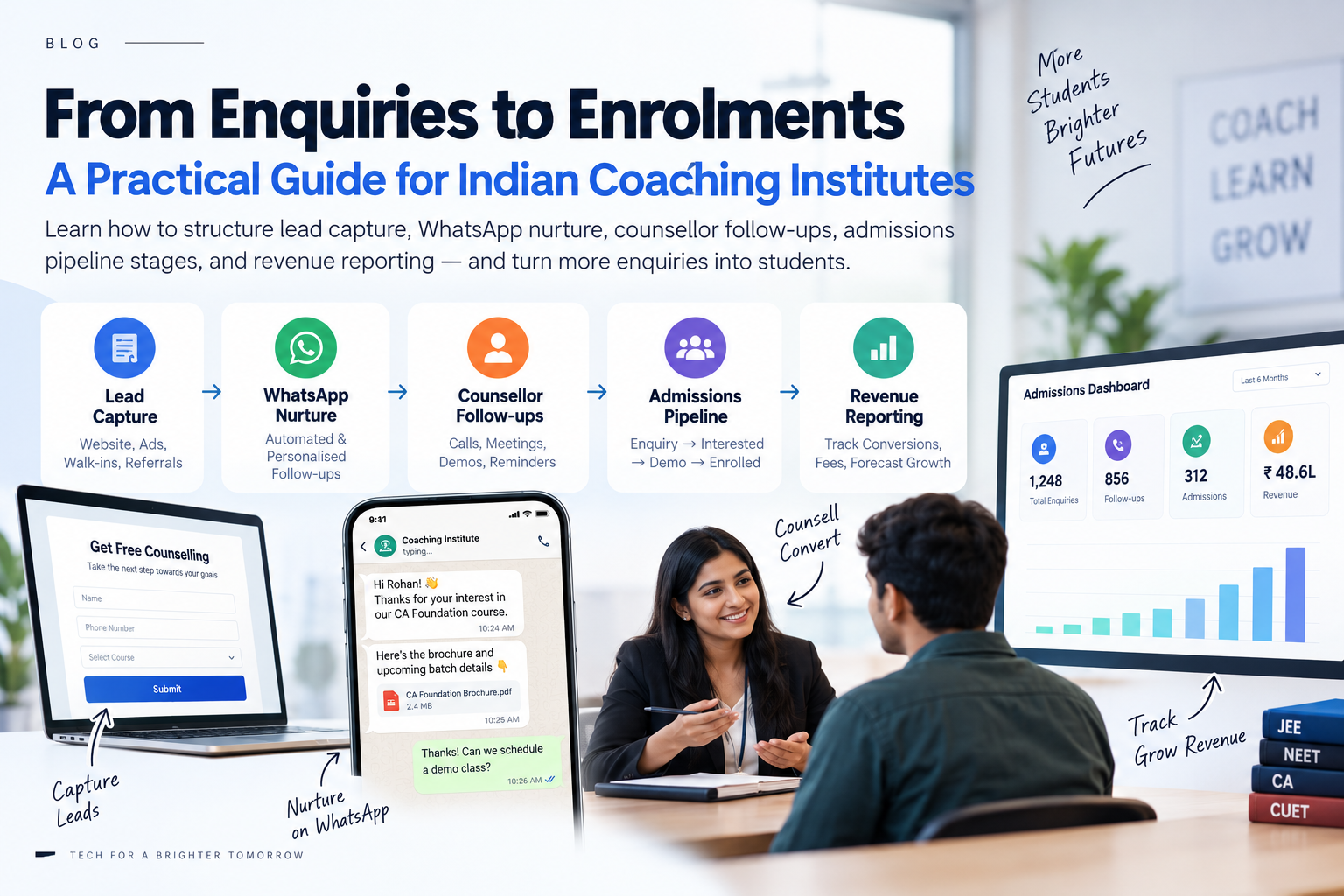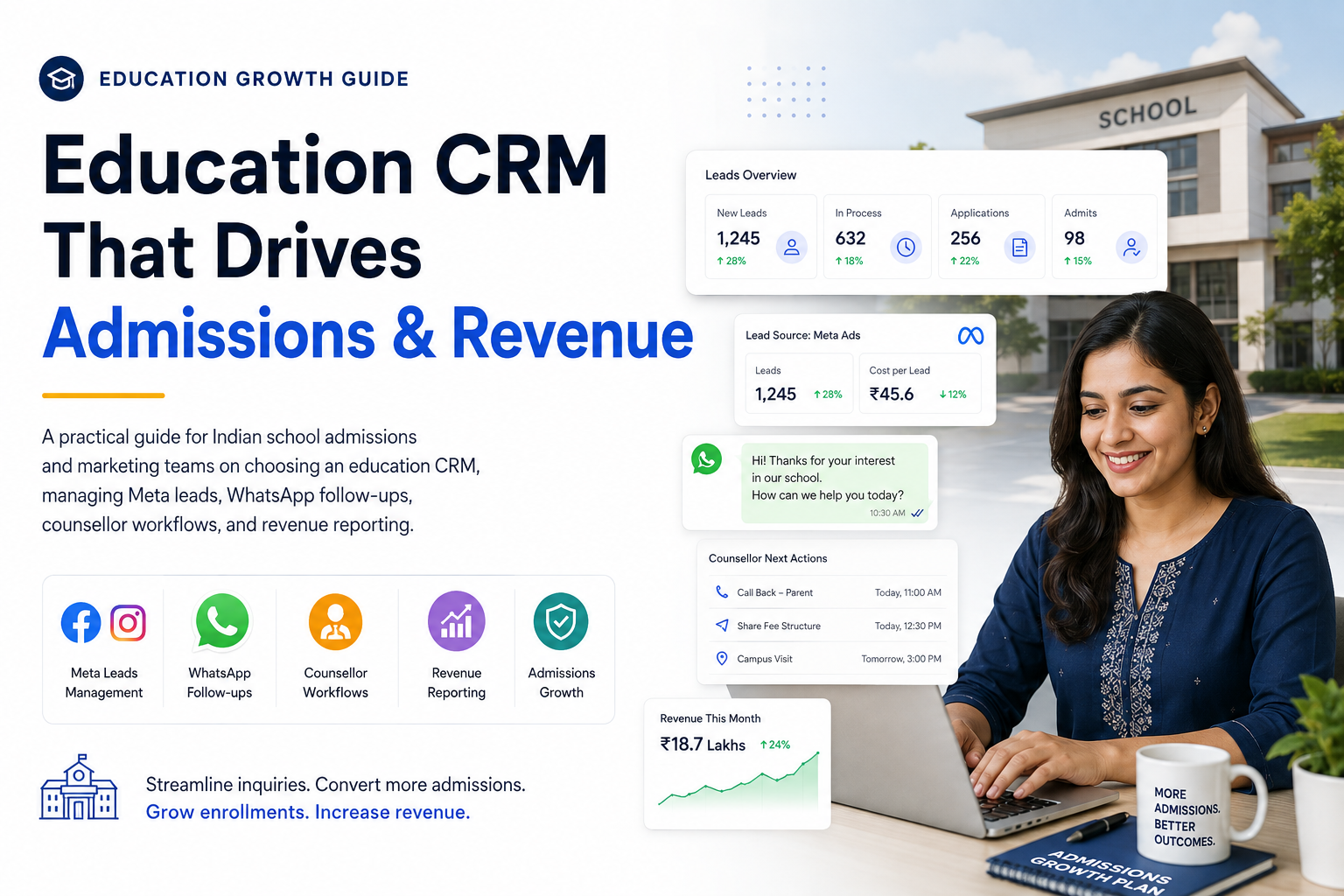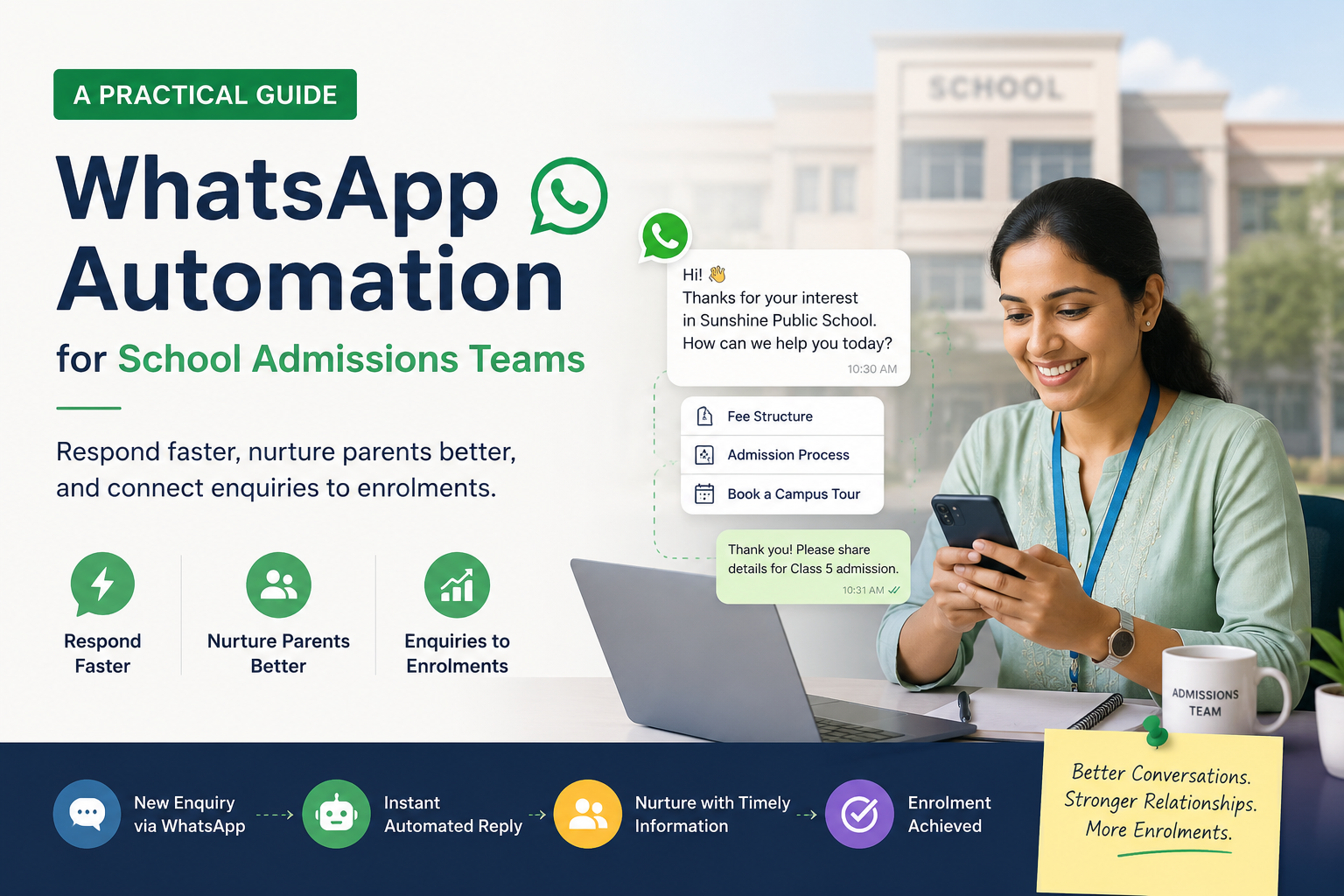
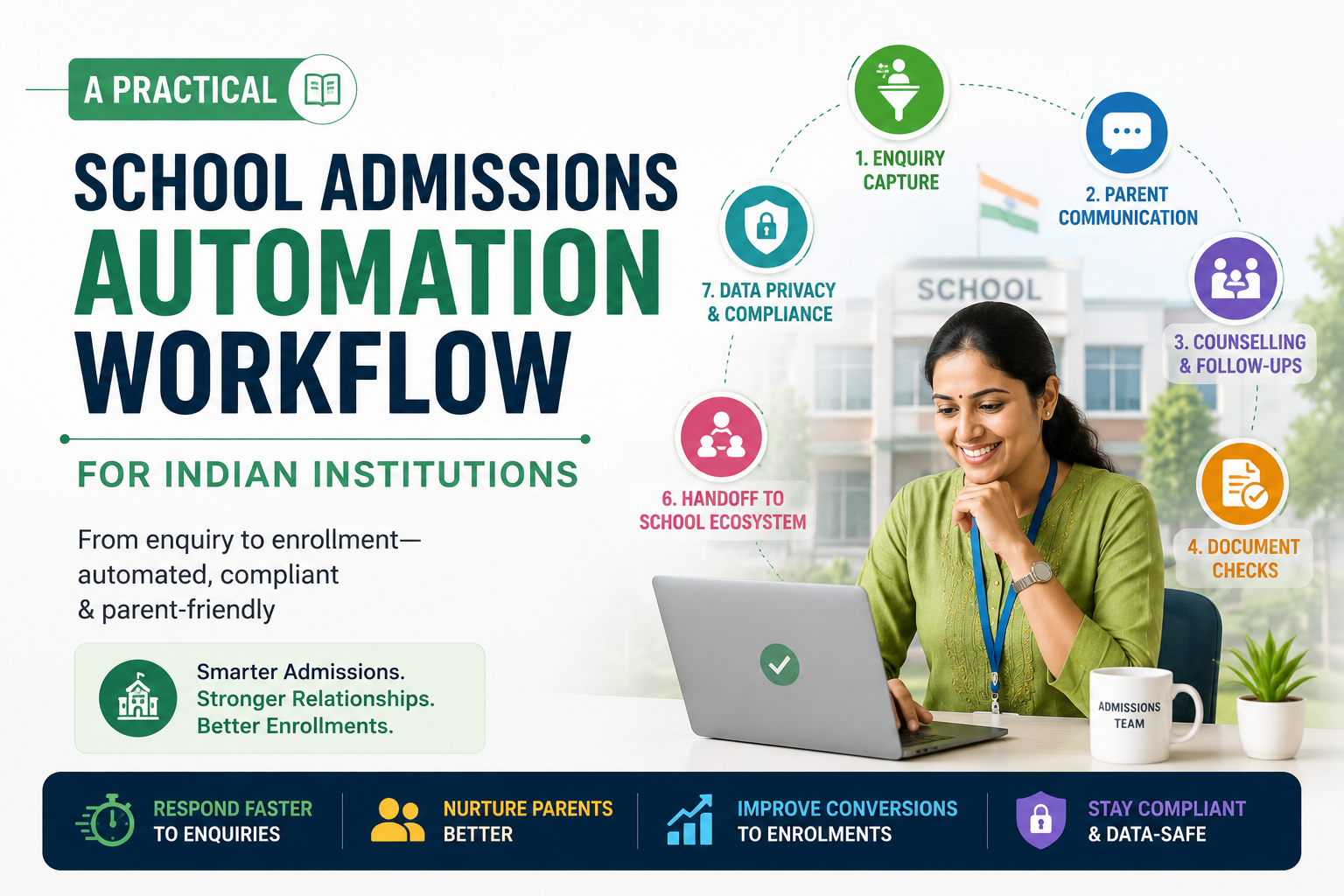
A school admissions automation workflow helps Indian institutions move each parent enquiry from first contact to confirmed enrollment with fewer missed follow-ups, clearer ownership, and better reporting. For principals, admission heads, counsellors, and school management teams, the goal is not to replace judgement. The goal is to make sure every serious family receives timely, accurate, and consistent guidance.
This matters because admissions teams now manage enquiries across websites, phone calls, walk-ins, WhatsApp, Meta ads, referrals, and education fairs. At the same time, families expect quick answers about fees, curriculum, transport, safety, classroom technology, and learning outcomes. A spreadsheet can record names, but it rarely shows which source produced enrolled students, which counsellor needs support, or where parents are dropping off.
Key Takeaways
- A good admissions workflow should track stages from enquiry capture to fee confirmation, not only store contact details.
- Automation works best when it supports counsellors with reminders, templates, prioritisation, and reporting.
- Indian schools should design admissions automation with consent, child data protection, and record-keeping discipline from the beginning.
- Smart classroom investments should be connected to parent communication so families understand how technology supports teaching and learning.
Why Indian Schools Need a Structured Admissions Workflow
Indian school admissions are high-context decisions. Parents are not only comparing fee structures. They are evaluating trust, teacher quality, board affiliation, campus safety, transport convenience, classroom experience, and the school's ability to communicate clearly. A structured workflow ensures that these questions are handled consistently across every enquiry source.
The scale of Indian schooling makes process discipline important. The Economic Survey 2024-25, citing UDISE+ 2023-24, reported that India's school education system serves 24.8 crore students across 14.72 lakh schools with 98 lakh teachers. The same PIB release noted that private schools account for 22.5 percent of schools and enroll 32.6 percent of students. Source: Press Information Bureau, 31 January 2025, https://www.pib.gov.in/PressReleasePage.aspx?PRID=2097864.
For an individual school, this means admissions work is both operational and strategic. A missed callback is not just an administrative delay. It can affect parent confidence. A weak handoff from marketing to counselling can waste advertising spend. An unclear document checklist can delay enrollment even after the family is convinced.
[INTERNAL-LINK: admissions growth strategy for Indian schools - supporting article on parent enquiry generation and lead source planning]
Before You Automate: Define the Admissions Journey
Start by mapping the real journey a parent follows. Most schools can use seven core stages: enquiry received, first response, qualification, campus visit or demo, application, document and fee verification, and enrollment handoff. Each stage should have one owner, one expected next action, and one clear success condition.
- Enquiry received: Capture source, parent name, child name, class sought, location, phone number, preferred language, and consent status.
- First response: Send an acknowledgement and assign a counsellor within a defined time window.
- Qualification: Understand class, board preference, commute, budget fit, sibling status, and admission timeline.
- Visit or demo: Schedule campus tour, principal interaction, classroom technology demo, or online counselling session.
- Application: Share form, eligibility criteria, document checklist, and deadline.
- Verification: Check documents, fee status, transport requirement, and academic eligibility.
- Enrollment handoff: Move the family to onboarding, class allocation, uniform, books, parent app access, and orientation.
This stage map is the backbone of the school admissions automation workflow. Without it, software becomes a digital version of an unclear manual process.
Step 1: Capture Every Enquiry in One System
The first automation priority is centralised enquiry capture. Website forms, Meta lead forms, WhatsApp messages, phone enquiries, walk-ins, referrals, and event leads should all enter one admissions pipeline. The admissions team should not have to reconcile five separate sheets at the end of the week.
Each enquiry record should answer four questions immediately: where did this parent come from, what class is the family interested in, who owns the next action, and when should the next follow-up happen? If these fields are missing, reporting will look busy but admissions decisions will remain unclear.
For schools using Swayam by ThirdMeta, this is where ad source, WhatsApp conversation, lead stage, counsellor ownership, and revenue or enrollment reporting can sit in one operating view. The public Swayam site describes a loop that connects Meta ads, WhatsApp follow-ups, CRM stages, AI briefing, and source-wise reports. Source: https://swayamapp.com.
[INTERNAL-LINK: how to track school enquiry sources - guide to UTM, campaign, referral, and walk-in tracking]
Step 2: Respond Quickly With Useful Parent Information
Automation should make the first response faster and more useful. A parent who asks about Class 6 admission should not receive a generic brochure meant for nursery admission. Segment the first response by class group, board, location, and enquiry source.
A practical first response template can include acknowledgement, counsellor name, school contact number, next step, available visit slots, and a short list of documents needed later. Keep the language clear. For Indian parents, bilingual or regional-language follow-ups may improve comprehension, especially for fee details, transport routes, and document requirements.
Use automation for reminders, not pressure. A good workflow sends a polite WhatsApp follow-up after a missed call, a visit reminder one day before the appointment, and a document checklist after the application stage. It should also stop unnecessary messages once the parent opts out, enrolls, or becomes inactive.
Step 3: Qualify Enquiries Without Losing Human Context
Qualification helps counsellors focus on families who are likely to need immediate attention. It should not be used to dismiss families too early. A useful qualification model includes class sought, admission urgency, distance from campus, board preference, fee fit, sibling status, and parent questions.
Schools can define simple lead temperatures. A hot enquiry may be a parent seeking admission this term, within the school's transport radius, who has requested a campus visit. A warm enquiry may be comparing schools for the next academic year. A cold enquiry may have incomplete information or no response after multiple respectful attempts.
AI-assisted notes can help here when used carefully. For example, the system can summarise the last WhatsApp exchange, suggest the next action, or flag unanswered fee questions. The counsellor should still verify context before making promises about seat availability, concessions, eligibility, or academic fit.
Practical rule: Automate the memory of the process, but keep the relationship human. Parents should feel guided, not processed.
Step 4: Connect Admissions With Smart Classroom Demonstrations
For schools investing in interactive flat panels and smart classroom solutions, admissions is a natural place to demonstrate how technology supports learning. Parents often ask whether digital classrooms are actually used by teachers or only shown during school tours. The admissions workflow should help the school answer that question with evidence.
NEP 2020 recognises technology as a way to improve teaching-learning, assessment, teacher development, educational access, and administration, including processes related to admissions, attendance, and assessments. Source: National Education Policy 2020, Ministry of Education, https://static.pib.gov.in/WriteReadData/userfiles/NEP_Final_English_0.pdf.
In practice, the school can add a smart classroom touchpoint to the visit stage. The counsellor can schedule a short classroom walkthrough, a teacher-led demonstration, or a subject-specific panel session. For example, a science teacher may show an interactive diagram, while a mathematics teacher may show problem-solving on the panel. This is more credible than a generic technology claim.
ThirdMeta's positioning around AI-powered interactive flat panels and smart classroom solutions can fit this admissions moment when the message stays educational: how teachers explain concepts, how students participate, how lessons are visualised, and how classroom technology supports the school's pedagogy.
[INTERNAL-LINK: smart classroom demonstration checklist - practical checklist for principals and admissions teams]
Step 5: Standardise Documents, Eligibility, and Fee Follow-Up
The application stage should reduce confusion. Parents should receive one accurate checklist by class and board requirement. The admissions team should be able to mark each document as pending, received, verified, or rejected with a reason.
For CBSE-affiliated schools, record discipline is especially important. CBSE's affiliation bye-laws state that schools should maintain records such as the admission and withdrawal register, and CBSE publishes examination bye-law resources for admission, transfer, and migration matters. Sources: https://www.cbse.gov.in/cbsenew/aff-bye-laws.html and https://www.cbse.gov.in/cbsenew/examinationbyelaws.html.
A practical automation workflow can include document upload links, missing-document reminders, internal verification tasks, fee payment status, receipt confirmation, and escalation to the admission head when an application is stuck. Avoid collecting unnecessary personal data. If a document is not needed for admission or compliance, do not request it by default.
Step 6: Protect Parent and Child Data
Admissions automation handles personal data about parents and children, so privacy cannot be treated as an afterthought. Schools should define what data is collected, why it is collected, who can access it, how long it is retained, and how parents can request correction or deletion where applicable.
The Digital Personal Data Protection Act, 2023 is India's central law for digital personal data processing. India Code lists provisions covering notice, consent, data fiduciary obligations, rights of data principals, grievance redressal, and processing of personal data of children. Source: India Code, https://www.indiacode.nic.in/handle/123456789/22037?view_type=browse.
For admissions teams, this translates into practical controls: collect consent for communication, limit access by role, avoid exporting student lists into unsecured personal devices, maintain an audit trail for changes, and review vendor data practices before connecting forms, WhatsApp tools, CRMs, or payment systems.
[INTERNAL-LINK: school data privacy checklist India - guide to consent, access control, retention, and vendor review]
Step 7: Measure What Actually Improves Enrollment
A useful admissions dashboard should show more than total enquiries. It should show source-to-enrollment performance, counsellor follow-up aging, stage-wise drop-offs, visit-to-application rate, application-to-fee rate, and common parent objections.
At minimum, review these metrics every week during admission season:
- Enquiries by source: Website, Meta ads, WhatsApp, referrals, walk-ins, events, and organic search.
- Speed to first response: How quickly counsellors contact new parents.
- Stage conversion: Enquiry to visit, visit to application, application to enrollment.
- Pending follow-ups: Parents due for callback, document reminders, fee reminders, or principal interaction.
- Lost reasons: Fees, distance, board preference, transport, seat availability, timing, or no response.
- Campaign quality: Which campaigns produced enrolled students, not only cheap leads.
This measurement approach helps school leaders make grounded decisions. If one campaign produces many enquiries but few visits, the issue may be targeting. If visits are strong but applications are weak, the issue may be counselling, fee communication, or parent confidence. If applications are strong but enrollment is delayed, document and fee workflows may need attention.
Common Mistakes to Avoid
Automating Before Fixing the Process
If the admissions stages are unclear, automation will only move confusion faster. Finalise stage definitions, ownership, and escalation rules before configuring software.
Using One Message for Every Parent
A nursery parent, Class 9 transfer parent, and senior secondary parent have different concerns. Segment communication by class, board, location, and stage.
Tracking Leads But Not Outcomes
Total lead count can be misleading. Track applications, confirmed admissions, revenue, and source quality so the school understands what is actually working.
Ignoring Counsellor Training
Even the best workflow depends on people. Train counsellors to update stages, record objections, respect opt-outs, and use templates without sounding mechanical.
Treating Smart Classroom Technology as a Brochure Point
Parents trust visible teaching practice more than feature lists. Use classroom demonstrations, teacher examples, and curriculum-linked use cases.
Frequently Asked Questions
What is a school admissions automation workflow?
A school admissions automation workflow is a defined process that captures enquiries, assigns counsellors, schedules follow-ups, shares parent communication, tracks applications, verifies documents, confirms fees, and reports enrollment outcomes in one system.
Can admissions automation work for small and mid-sized Indian schools?
Yes. Smaller schools often benefit because the same team handles calls, WhatsApp, visits, and reporting. Start with enquiry capture, follow-up reminders, and stage tracking before adding advanced reporting or AI assistance.
Should schools automate WhatsApp communication?
Schools can automate acknowledgements, visit reminders, document checklists, and fee follow-ups, but sensitive conversations should remain human-led. Always respect consent, opt-outs, and parent preferences.
How does smart classroom technology support admissions?
Smart classroom technology supports admissions when parents can see how teachers use interactive panels and digital content in real lessons. It should be positioned as a teaching aid, not a standalone promise of better outcomes.
What should principals check before choosing an admissions CRM?
Principals should check enquiry source tracking, WhatsApp integration, role-based access, consent capture, document workflows, reporting, ease of use for counsellors, vendor support, and data protection practices.
Conclusion
A practical school admissions automation workflow gives Indian institutions a clearer way to manage parent interest from enquiry to enrollment. The best workflow is simple enough for counsellors to use every day and strong enough for leaders to review with confidence.
For schools evaluating smart classroom technology, admissions is also an opportunity to show how classroom tools support real teaching. When enquiry capture, parent communication, counselling, document checks, and classroom demonstrations work together, the school presents a more organised and trustworthy experience.
[INTERNAL-LINK: choosing smart classroom solutions for Indian schools - next-step guide for principals and education decision-makers]