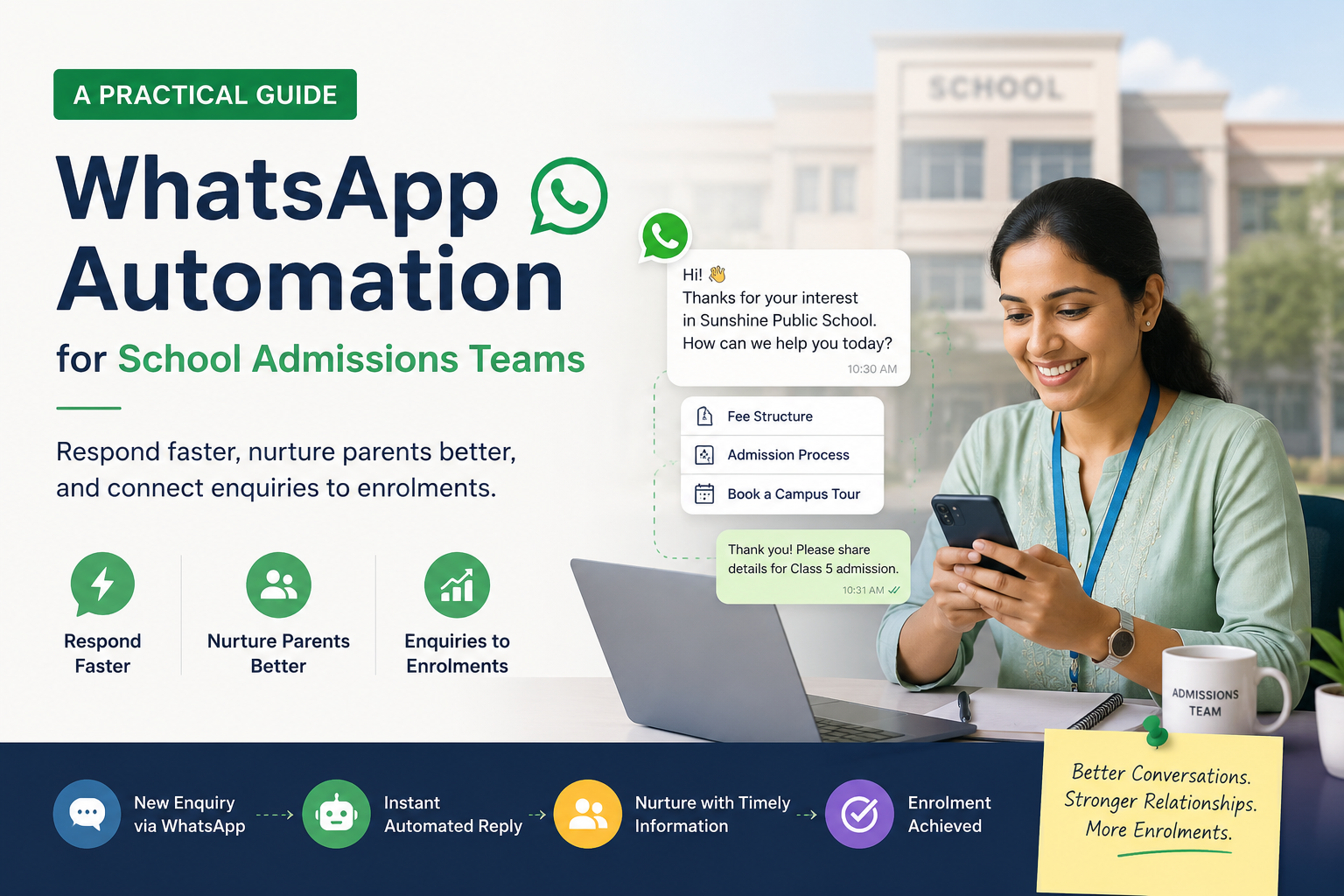
WhatsApp automation for school admissions helps schools convert more admission enquiries by reducing response delays, standardising parent follow-up, and giving admissions teams a single view of every enquiry from ad click to enrolment decision.
School admission enquiry WhatsApp workflow (India)
A school admission enquiry WhatsApp workflow in India is the repeatable path from a parent's first message to a qualified campus visit or application step—every reply logged, timed, and owned by a counsellor instead of scattered across personal phones. When families message from Click-to-WhatsApp ads, the school website, or a saved business number, the workflow should capture child grade, campus, and consent; send an immediate acknowledgement inside Meta's session window; answer predictable questions with approved templates; and escalate nuanced fee, curriculum, or safety topics to a named counsellor with SLA reminders. Peak K-12 seasons stack hundreds of parallel threads from nursery through senior grades, so measurable response time matters as much as tone. Connecting the same thread to CRM pipeline stages lets principals see which sources produce enrolled students—not screenshot folders. Teams evaluating software-first automation can compare an admissions revenue system for schools with the broader Swayam AI Labs platform for CRM, WhatsApp, and workflow modules on one stack.
| Parent question | Automated reply | Counsellor handoff trigger |
|---|---|---|
| What is the fee for Grade 1 / transport / annual charges? | Share approved fee band PDF or campus-specific range plus link to fee policy page. | Parent asks for discount, sibling concession, or custom payment plan. |
| Is there a seat for my child's class this year? | Confirm intake status, next open house date, and document checklist template. | Waitlist edge case, mid-year transfer, or special-needs accommodation. |
| Can we schedule a campus visit? | Offer two visit slots via calendar link and send location + parking note. | Parent requests principal meeting, board-specific curriculum deep-dive, or trial day. |
| We filled the form—what happens next? | Acknowledge receipt, name assigned counsellor, and expected callback window. | No response after two automated nudges or parent marks enquiry as urgent. |
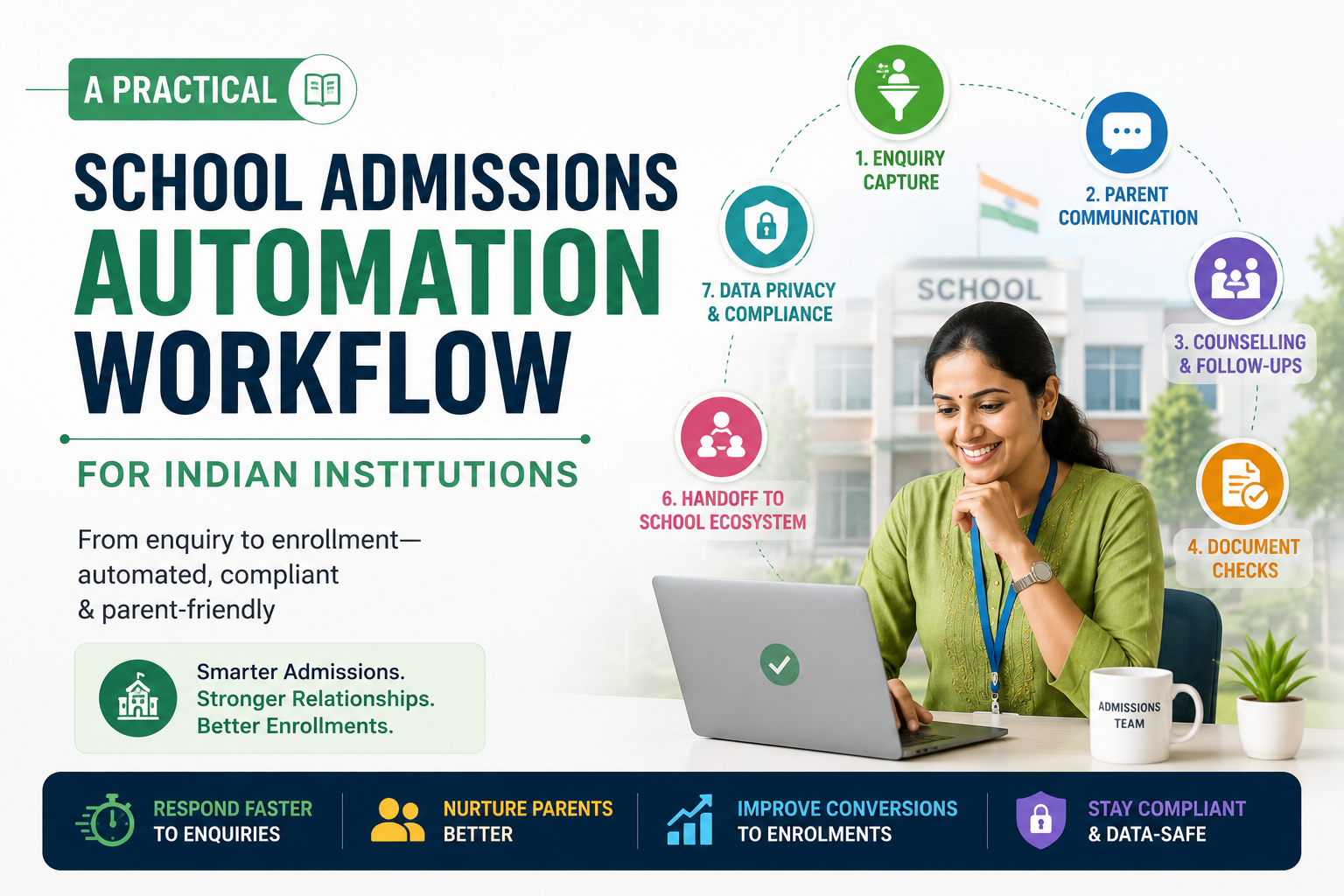
For stage-by-stage enquiry-to-enrolment design—owners, SLAs, and when to automate versus keep counsellors on fee conversations—see our school admission automation workflow for India.
For Indian schools, the opportunity is large and competitive. The UDISE+ portal lists 14.67 lakh schools and 24.72 crore students in India, which shows the scale of parent choice and admission pressure across the market. Source: UDISE+, https://udiseplus.gov.in, retrieved 13 August 2026.
The case for messaging is also practical, not speculative. Meta's State of Business Messaging report, based on a Kantar survey of 11,056 online adults across 22 markets including India in April to September 2025, reports that 73.3% of consumers prefer messaging when communicating with a business. Source: WhatsApp Business, https://whatsappbusiness.com/resources/resource-library/state-of-business-messaging/.
Key Takeaways
- Admissions teams lose momentum when enquiries from Meta ads, forms, calls, and walk-ins sit in separate tools.
- WhatsApp automation works best when it handles instant acknowledgement, qualification, reminders, document prompts, and counsellor handoffs.
- Automation should support counsellors, not replace them. Complex fee, curriculum, transport, and fit questions still need human judgement.
- The best systems measure source, response time, follow-up ageing, visit bookings, application progress, and admissions won.
Why School Admission Enquiries Need Faster Follow-Up
Parents usually enquire when intent is active. They may have just seen an ad, compared fees, asked another parent, or shortlisted schools near home. If the first response is delayed, the enquiry can move from interested to cold before a counsellor opens the sheet.
The well-known Lead Response Management study by Dr. James Oldroyd and InsideSales.com found that the odds of contacting a web-generated lead fall sharply when the first attempt moves from five minutes to thirty minutes. The study is not school-specific and was published in 2007, so it should be used as a speed-to-lead benchmark rather than an admissions conversion guarantee. Source: https://www.onecavo.com/wp-content/uploads/2015/11/MIT-InsideSales.com_Lead-Response-Management.pdf.
In admissions, the same operating principle applies. A parent who fills a nursery, Grade 1, Grade 6, or Grade 11 enquiry form is expecting clarity. A fast WhatsApp acknowledgement tells them the school has received the enquiry, explains the next step, and gives the counsellor time to respond with context.
Where WhatsApp Automation Fits In The Admissions Funnel
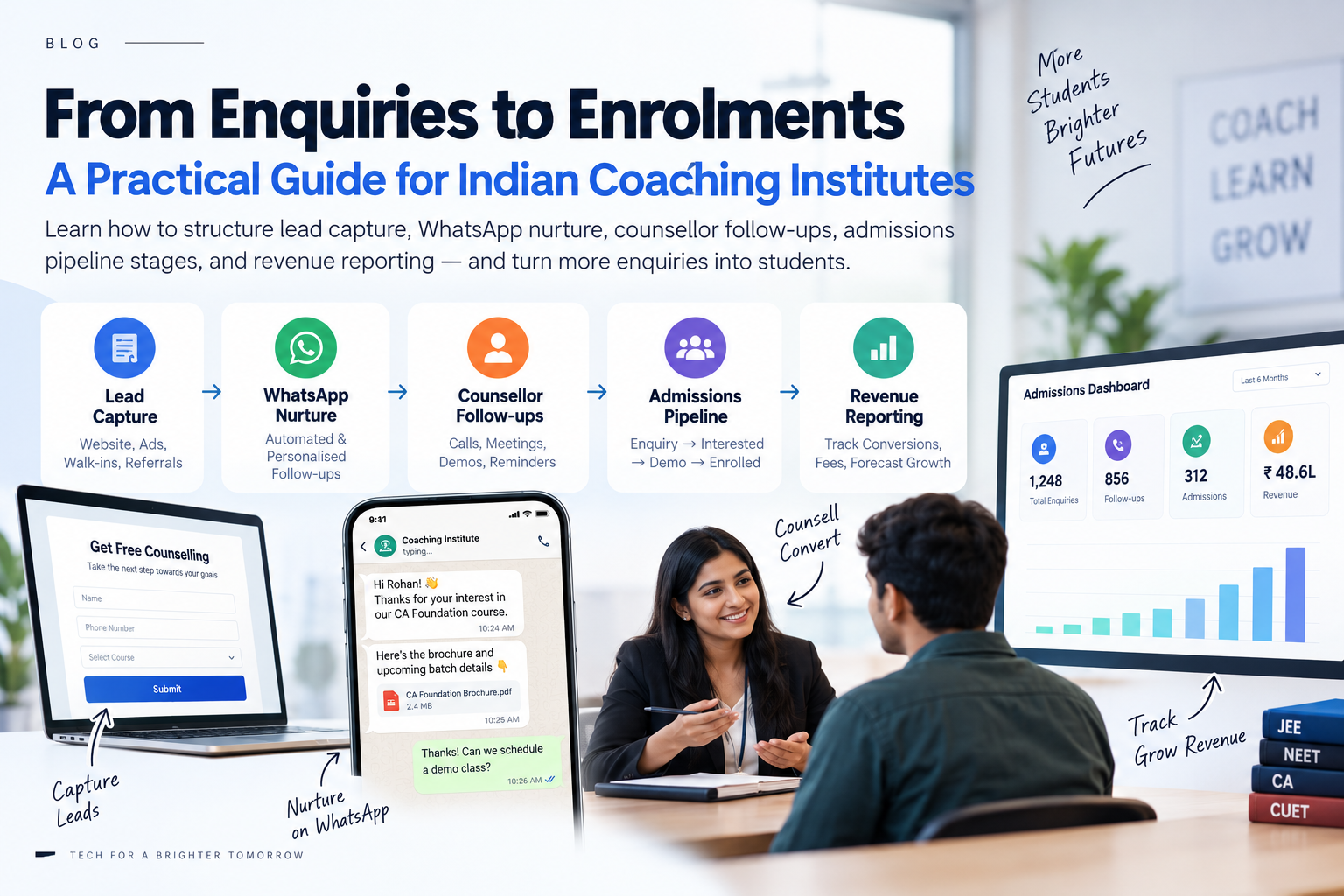
WhatsApp automation should sit between lead capture and counsellor action. It should not be a loose broadcast tool. The workflow works when every message is tied to a lead record, source, grade, campus, counsellor owner, and current pipeline stage.
Capture
Every enquiry from Meta lead forms, Click-to-WhatsApp ads, website forms, offline events, referrals, and walk-ins should enter the same CRM. This avoids duplicate parent records and gives the team one admissions pipeline instead of scattered spreadsheets.
Qualify
Automation can ask structured questions such as grade sought, preferred campus, location, curriculum interest, sibling status, transport need, and intended admission timeline. These answers help the team prioritise serious enquiries without making parents repeat details on a call.
Nurture
Parents rarely decide after one message. A useful nurture flow sends relevant information in sequence: fee range, curriculum highlights, campus visit slots, document checklist, admission process, scholarship or assessment details when applicable, and deadline reminders.
Handoff
When a parent asks a specific question or shows high intent, the automation should assign the lead to a counsellor with a clear next action. The counsellor should see the conversation history, not just the phone number.
What Schools Should Automate First
The best starting point is not a long chatbot. Schools should automate the repetitive moments that are easy to define and costly to miss.
- Instant acknowledgement: Confirm that the enquiry was received and mention when the admissions team will respond.
- Basic qualification: Ask for grade, campus, curriculum, locality, and preferred callback time.
- Campus visit booking: Offer available visit slots and send reminders before the appointment.
- Application nudges: Remind parents about pending forms, documents, assessments, and payment steps.
- Counsellor reminders: Alert the owner when a lead has gone quiet, missed a visit, or replied with buying intent.
- Source tracking: Keep Meta campaign, UTM, referral, and offline source data attached to the lead record.
This is where an agentic CRM such as Swayam is relevant for admissions teams evaluating growth systems. Swayam connects Meta ads, WhatsApp nurture, pipeline stages, and revenue reporting so teams can see which enquiries are moving toward admission, not only which campaigns created leads. Source: https://swayamapp.com.
How WhatsApp Automation Improves Admission Conversion Quality
Automation improves conversion quality when it makes the admissions process more consistent. It does this in four practical ways.
- It reduces missed enquiries: New leads are acknowledged even when counsellors are in calls, parent meetings, assemblies, or campus tours.
- It improves parent context: Parents receive the right next step instead of a generic brochure dump.
- It protects counsellor time: Counsellors can focus on fit, objections, campus visit quality, and closing conversations.
- It creates management visibility: Leaders can review response time, pending follow-ups, source ROI, counsellor workload, and stage-wise drop-offs.
Meta's WhatsApp Business Platform pricing page also matters for planning. Meta says businesses using the platform are charged on a per-message basis for delivered messages, with rates varying by market and category. The four categories are marketing, utility, authentication, and service. Source: https://whatsappbusiness.com/products/platform-pricing/.
That pricing model encourages disciplined messaging. Schools should avoid sending too many broad promotional messages and instead design targeted flows based on grade, campus, stage, and parent action.
What Not To Automate
Not every admissions conversation should be automated. Parents are making a high-trust decision, often involving fees, child readiness, commute time, language comfort, peer environment, special needs, and long-term academic fit.
- Do not automate sensitive counselling: Questions about child fit, learning support, behavioural needs, or family constraints should move to a trained counsellor.
- Do not hide fees behind vague messages: If fee ranges can be shared, make them clear. If they vary, explain what affects the range.
- Do not over-message cold leads: Give parents a useful path to opt out or pause communication.
- Do not treat every lead equally: A parent asking for a campus visit needs a different workflow from a parent casually downloading a brochure.
A Practical WhatsApp Admissions Workflow
A school can start with a simple seven-step workflow and improve it after the first admission cycle.
- Lead enters CRM: Capture source, campaign, grade, campus, parent name, and phone number.
- WhatsApp acknowledgement is sent: Confirm receipt and ask one or two qualifying questions.
- Lead is scored: Prioritise based on grade availability, location, timeline, visit request, and reply intent.
- Counsellor is assigned: Route by campus, grade, language, or workload.
- Parent receives next-step nurture: Send relevant information, not a generic sequence.
- Visit or call is booked: Confirm the appointment and send reminders.
- Outcome is tracked: Mark won, lost, deferred, not eligible, duplicate, or future intake with reasons.
The important point is measurement. If a campaign brings many enquiries but few campus visits, the issue may be targeting. If many parents visit but do not apply, the issue may be counselling, fee clarity, or fit. If many applications remain incomplete, the issue may be document follow-up. WhatsApp automation helps only when these signals are visible.
Metrics Admissions Leaders Should Track
Admissions heads and marketing teams should judge WhatsApp automation by pipeline movement, not message volume. The most useful metrics are operational and revenue-linked.
- First response time: How quickly each new enquiry receives a useful reply.
- Lead-to-qualified rate: How many enquiries provide enough information for counsellor follow-up.
- Qualified-to-visit rate: How many serious parents book a campus visit or counselling call.
- Visit-to-application rate: How many visits turn into applications.
- Application completion rate: How many started applications finish the required steps.
- Source-to-admission ROI: Which ads, campaigns, referrals, or organic channels produce actual admissions.
- Follow-up ageing: How many leads are overdue by counsellor, grade, or campus.
These metrics help leaders separate a lead generation problem from a follow-up problem. That distinction is essential when deciding whether to increase ad spend, change counsellor allocation, improve messaging, or tighten admission criteria.
How To Choose A WhatsApp Automation System For School Admissions
When evaluating CRM and WhatsApp automation platforms, schools should look beyond the ability to send messages. The system should support the full admissions operating rhythm.
- Meta ads integration: Can the system capture campaign and source data automatically?
- WhatsApp Business Platform support: Can it manage approved templates, replies, and stage-based automation responsibly?
- Admissions pipeline: Can the team track enquiry, qualified, visit booked, visited, applied, admitted, lost, and deferred stages?
- Team ownership: Can leads be assigned, reassigned, and reviewed without losing history?
- Reporting: Can leadership see source ROI, counsellor performance, stage drop-offs, and revenue outcomes?
- Implementation support: Will the vendor help design workflows, templates, and reporting, or only provide software access?
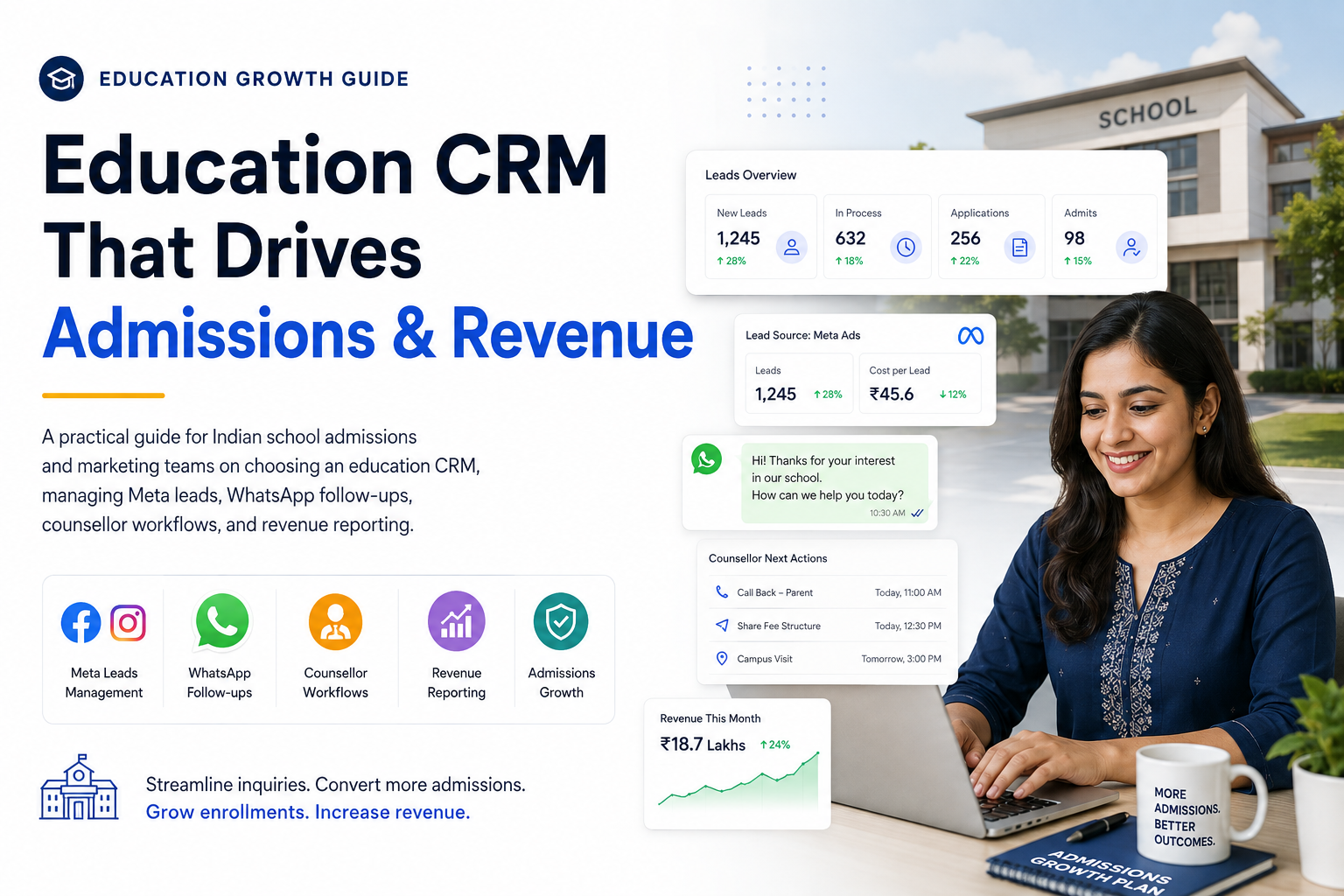
Swayam positions itself as an agentic CRM for teams that want Meta ads, WhatsApp follow-up, and pipeline operations in one revenue loop. For schools, the evaluation question is simple: can the system show which enquiries became admissions and why others dropped off?
Conclusion
WhatsApp automation for school admissions is useful because it solves a real operating problem: admissions teams need to respond quickly, follow up consistently, and measure what happens after every enquiry.
The strongest approach is balanced. Automate the repetitive parts of the journey, keep counsellors focused on high-trust conversations, and connect every message to the admissions pipeline. When schools do that, WhatsApp becomes more than a communication channel. It becomes a measurable part of the admission conversion system.