School admission CRM for India K-12
A school admission CRM for India K-12 is the shared system where every parent enquiry—from Meta lead ads, website forms, walk-ins, referrals, or WhatsApp—gets one profile, one owner, and one next action until the child is admitted, waitlisted, or closed with a documented reason. Independent schools and multi-campus groups running nursery through Class XII need grade-aware pipelines, branch routing, consent-safe messaging, and source-to-enrolment reporting instead of counsellor spreadsheets and screenshot folders. The CRM should capture child grade, curriculum fit, sibling status, visit outcomes, fee-stage progress, and lost reasons so principals see enrolled students per campaign—not vanity lead counts. During peak admission windows, response-time SLAs and queue visibility matter as much as polite templates. Platform-backed automation keeps counsellors on one timeline while leadership compares branch performance. Teams evaluating software-first options can compare an admissions revenue system for K-12 schools with the Swayam AI Labs platform for enquiry capture, counsellor tasks, WhatsApp, and revenue ops on one stack.
| Parent touchpoint | CRM record | Counsellor next step |
|---|---|---|
| Meta lead ad or website form submitted | New enquiry with grade, campus, source tag, and consent flags | First call inside SLA; qualify budget, timeline, and curriculum fit |
| WhatsApp reply after open day or fee question | Thread linked to lead; template sends and parent replies logged | Share approved fee band; escalate discount or sibling concession to senior counsellor |
| Campus visit or walk-in at reception | Visit logged with interest level, objections, and preferred intake | Send application pack, document checklist, and visit follow-up task |
| No response after visit or fee quote | Ageing task with last touchpoint and pipeline stage | Recovery call; offer new slot or close as lost with reason code |
School admission follow-up CRM for India K-12
School admission follow-up CRM for India K-12 is the counsellor operating layer on top of enquiry capture: every parent thread gets a timed next action, a logged WhatsApp conversation on the lead record, and a visible SLA so no enquiry ages in a personal phone or spreadsheet row. Peak admission seasons break when follow-ups depend on memory—missed callbacks after campus visits, duplicate WhatsApp nudges from two counsellors, or fee quotes sent without a task for day-three recovery. A follow-up CRM ties each enquiry stage to a follow-up window, records the CRM fields that must be filled before the stage advances, and tells the counsellor exactly what to do next on call or WhatsApp. Principals can audit response times by branch and campaign instead of asking counsellors to export screenshots. For a step-by-step 48-hour recovery playbook, see our admission enquiry follow-up playbook (India); for vendor scorecards while you redesign follow-up, use the K-12 admission CRM evaluation checklist for India.
| Enquiry stage | Follow-up window | CRM field | Counsellor action |
|---|---|---|---|
| New enquiry (form or ad) | Within 15 minutes (hot); same business day (warm) | Source tag, grade, campus, consent flag, owner | Qualify intent; schedule call or campus visit |
| Contacted / qualified | 24–48 hours between touches | Interest level, objections, next task date | Share curriculum fit, fee band, and visit slots |
| Visit completed | 48 hours post-visit | Visit notes, application status, fee stage | Send checklist; confirm application start or close lost |
| Application / fee discussion | 72 hours if no parent reply | Fee quote logged, sibling concession flag | Recovery WhatsApp or call; escalate discount if needed |
| No response / stalled | Day 3 and day 7 recovery | Last touch channel, lost-reason code if closing | One structured recovery attempt; then mark lost with reason |
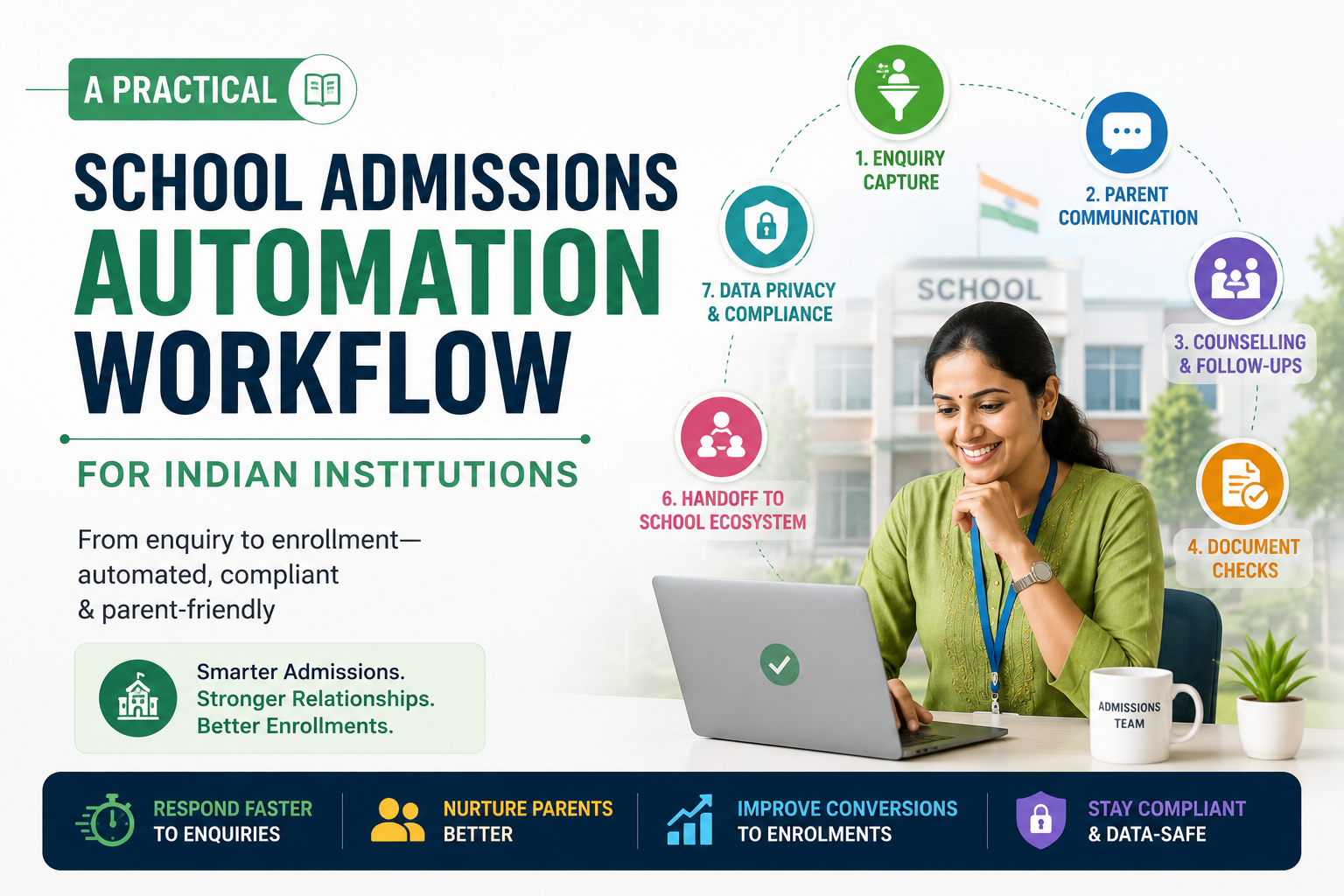
Follow-up workflow depth: This post helps you evaluate CRM software and vendor fit. Operational stage design—who owns the next call after a campus visit, which WhatsApp nudges fire at 48 hours, and how automation hands off to counsellors for fee conversations—lives in our school admission automation workflow playbook (India) so follow-up queries land on one canonical URL.
For stage-by-stage enquiry-to-enrolment design—owners, SLAs, and when to automate versus keep counsellors on fee conversations—see our school admission automation workflow for India.
For follow-up SLAs, enquiry-stage automation, and a single hub that links workflow depth with CRM evaluation, see our school admission follow-up CRM workflows guide (India).
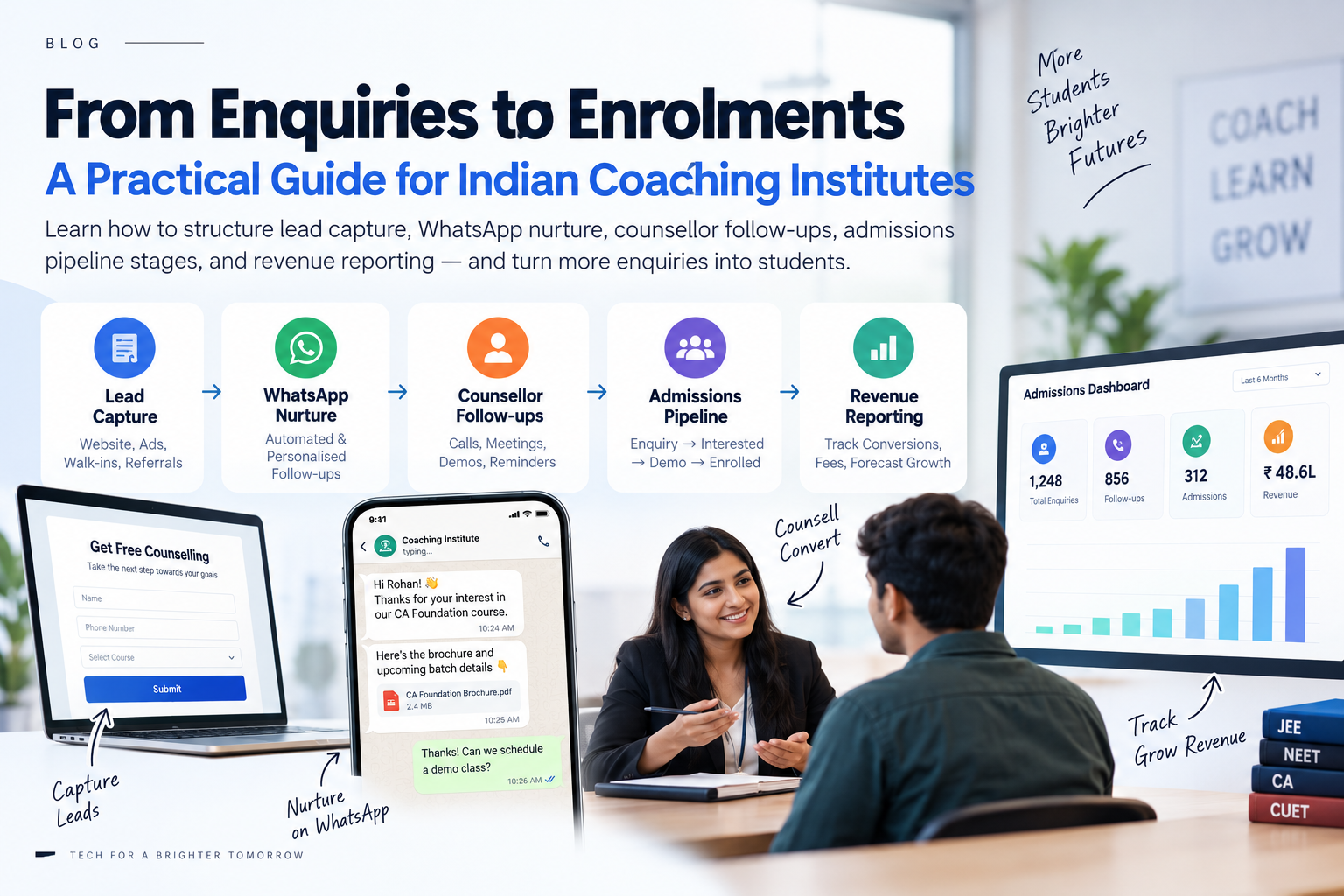
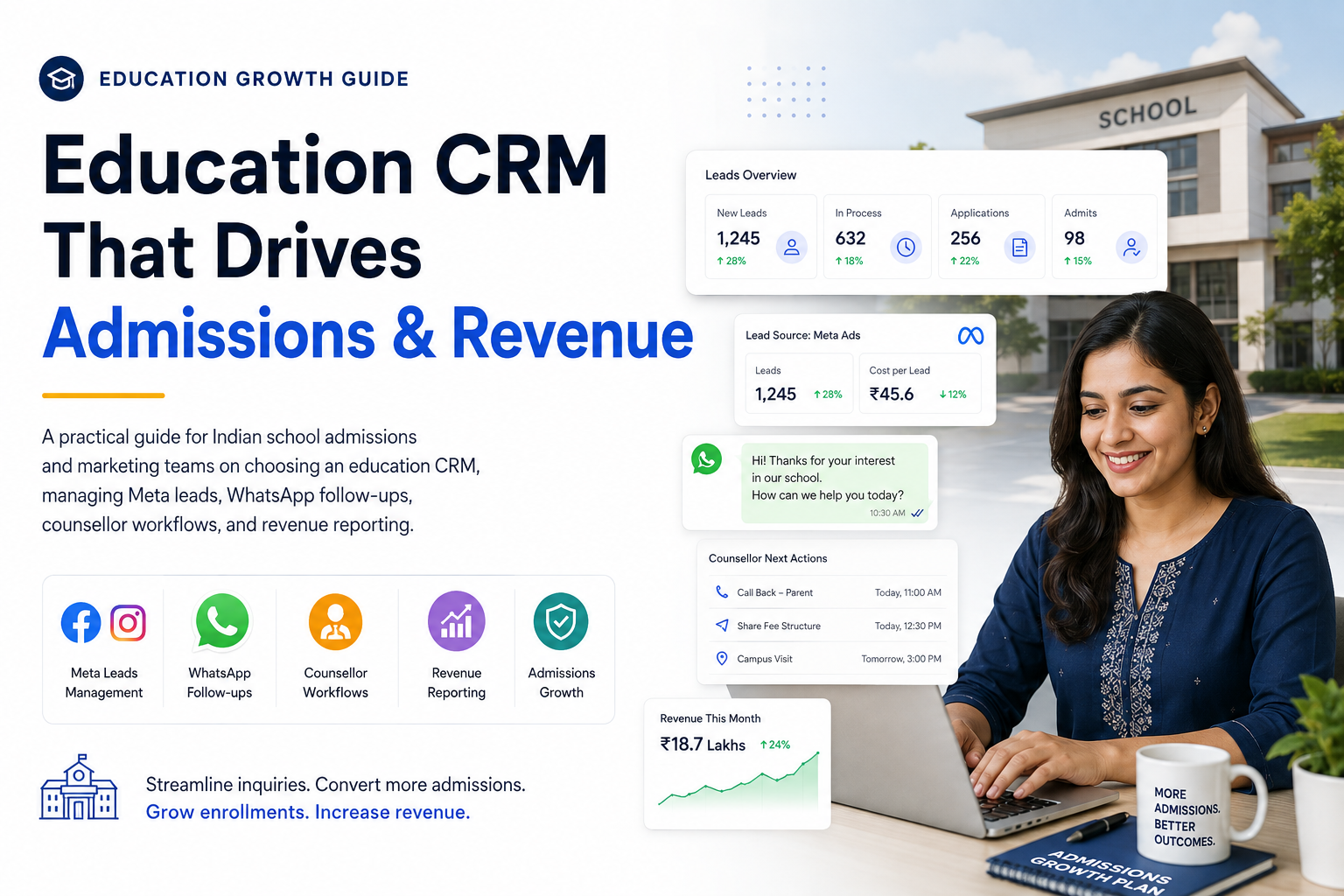
An education CRM for schools in India should do more than store enquiry forms. It should capture leads from every source, assign them quickly, guide counsellor follow-ups, manage WhatsApp communication responsibly, and show which campaigns actually turn into admissions.
Key Takeaways
- Indian schools need admissions systems built around speed, parent communication, counsellor ownership, and source-to-admission reporting.
- UDISE+ shows the scale of Indian school education: the official portal reports 14.67 lakh schools, while the Ministry of Education's 2025-26 release shows secondary retention improving from 47.2% in 2024-25 to 51.9% in 2025-26.
- WhatsApp can be useful for admissions nurture, but teams should design opt-in, template, consent, and handoff rules before automating messages.
- The right CRM should connect Meta ads, website forms, phone calls, walk-ins, WhatsApp, counsellor tasks, and fee-stage reporting in one operating system.
- Schools should evaluate CRM vendors on workflow fit, data protection, reporting depth, implementation support, and adoption by counsellors.
Evaluating software? See how independent schools and school groups run enquiry capture, counsellor queues, and WhatsApp follow-up on the Admissions Revenue System (K-12 section), or use our K-12 admission CRM evaluation checklist for India.
What Is an Education CRM for Schools?
An education CRM for schools is a system for managing admissions enquiries from first contact to enrolment. In a school context, that usually means tracking parent enquiries, student details, grade interest, branch preference, source, counsellor ownership, follow-up history, documents, visits, application status, and admission outcome.
A general CRM can hold contacts, but a school admissions CRM needs education-specific workflows. Admissions teams need to know whether a lead came from Meta, Google, a school website, a referral, a phone call, a fair, or a walk-in. They also need to see whether that enquiry has been called, qualified, invited for a campus visit, sent fee details, moved to application, or marked lost with a reason.
The core components are:
- Lead capture: Forms, Meta lead ads, website enquiries, call logs, WhatsApp, imports, and offline walk-ins.
- Lead qualification: Grade, curriculum, location, budget fit, sibling status, urgency, and parent intent.
- Pipeline management: Clear stages such as new enquiry, contacted, qualified, visit scheduled, application started, offer made, enrolled, and lost.
- Communication history: Calls, WhatsApp messages, templates, notes, reminders, and parent objections.
- Revenue reporting: Source-wise admissions, counsellor performance, campaign ROI, fee-stage progress, and lost reasons.
For a deeper cluster article, add [INTERNAL-LINK: admissions CRM workflow for schools - detailed process guide].
Why Schools in India Need a CRM for Admissions Leads
Schools in India need a CRM because admissions now happen across multiple channels at once. Parents may see a Meta ad, message on WhatsApp, call the front desk, visit the campus, and then compare fee structures with two other schools before making a decision. Without a central system, follow-ups become dependent on spreadsheets, individual counsellor memory, and disconnected inboxes.
The scale is large. UDISE+ reports 14.67 lakh schools on its official portal. The Ministry of Education's UDISE+ 2025-26 release also shows that retention remains an important operating metric: secondary retention improved from 47.2% in 2024-25 to 51.9% in 2025-26, while secondary dropout fell from 8.2% to 7.0%. Admissions teams are not just filling seats; they are operating inside a large, competitive, retention-sensitive education system.
Digital behaviour has changed the front end of admissions. IBEF, summarising the IAMAI-Kantar Internet in India 2024 report, reported 886 million active internet users in India in 2024, with rural India accounting for 55% of users. That matters for schools because parent discovery is no longer limited to hoardings, local referrals, and newspaper ads. Search, social, WhatsApp, and vernacular digital content influence how families shortlist schools.
A CRM becomes valuable when it turns that fragmented demand into accountable admissions work. The practical goal is simple: no enquiry should be missed, every parent should get a relevant next step, and leadership should know which sources are producing enrolled students, not just leads.
Where Admissions Leads Usually Break Down
Admissions leads usually break down at handoff points. The most common failure is not poor advertising; it is losing context between lead generation, first call, parent nurture, campus visit, application, and fee payment.
Typical breakdowns include:
- Slow first response: A parent submits a form but receives a call hours later, after they have contacted another school.
- Duplicate records: The same parent appears in Meta leads, WhatsApp, website forms, and a counsellor spreadsheet.
- No qualification logic: Counsellors spend equal time on high-intent and low-fit enquiries.
- Weak WhatsApp tracking: Important parent replies stay in personal phones or shared inboxes with no pipeline context.
- No lost reason discipline: Leadership sees low conversion but cannot tell whether the issue is fees, distance, curriculum, timing, counsellor follow-up, or lead quality.
- Campaign reporting stops at leads: Marketing celebrates cost per lead while admissions cares about cost per enrolled student.
This is why a CRM should be designed around the admissions journey, not just the contact database. A useful pipeline makes the next action obvious: call now, send fee details, schedule a tour, assign to a senior counsellor, follow up after visit, collect documents, or close as lost with a reason.
For supporting content, add [INTERNAL-LINK: how to reduce admissions lead leakage - operational checklist].
What a Good School Admissions Pipeline Should Track
A good school admissions pipeline should track both parent intent and team action. The best pipeline is not the most complex one; it is the one counsellors can update consistently while leadership still gets meaningful reporting.
Recommended Pipeline Stages
- New enquiry: The lead has entered the CRM but no meaningful contact has happened.
- Contacted: A counsellor has spoken to the parent or sent the first verified response.
- Qualified: Grade, location, budget, curriculum interest, and timeline are understood.
- Visit or counselling scheduled: The parent has committed to a next step.
- Visit completed: The family has attended a campus visit, counselling session, or orientation.
- Application started: The parent has begun documents, form submission, assessment, or internal approval.
- Offer or fee stage: Admission is likely but payment, documents, or final confirmation is pending.
- Enrolled: Admission is confirmed according to the school's internal definition.
- Lost: The family did not proceed, with a required reason.
Fields That Matter
At minimum, schools should track parent name, phone number, student name, grade, academic year, branch, curriculum, location, source, campaign, counsellor owner, last contact date, next follow-up date, stage, priority, and lost reason. For multi-branch schools, branch preference and distance are often essential. For premium schools, budget fit and visit completion may be stronger intent indicators than raw enquiry count.
The CRM should also preserve source metadata such as UTM parameters, Meta campaign name, ad set, form name, and landing page. Without this data, a school can count leads but cannot reliably compare revenue impact by campaign or channel.
How WhatsApp Automation Should Fit Into Admissions
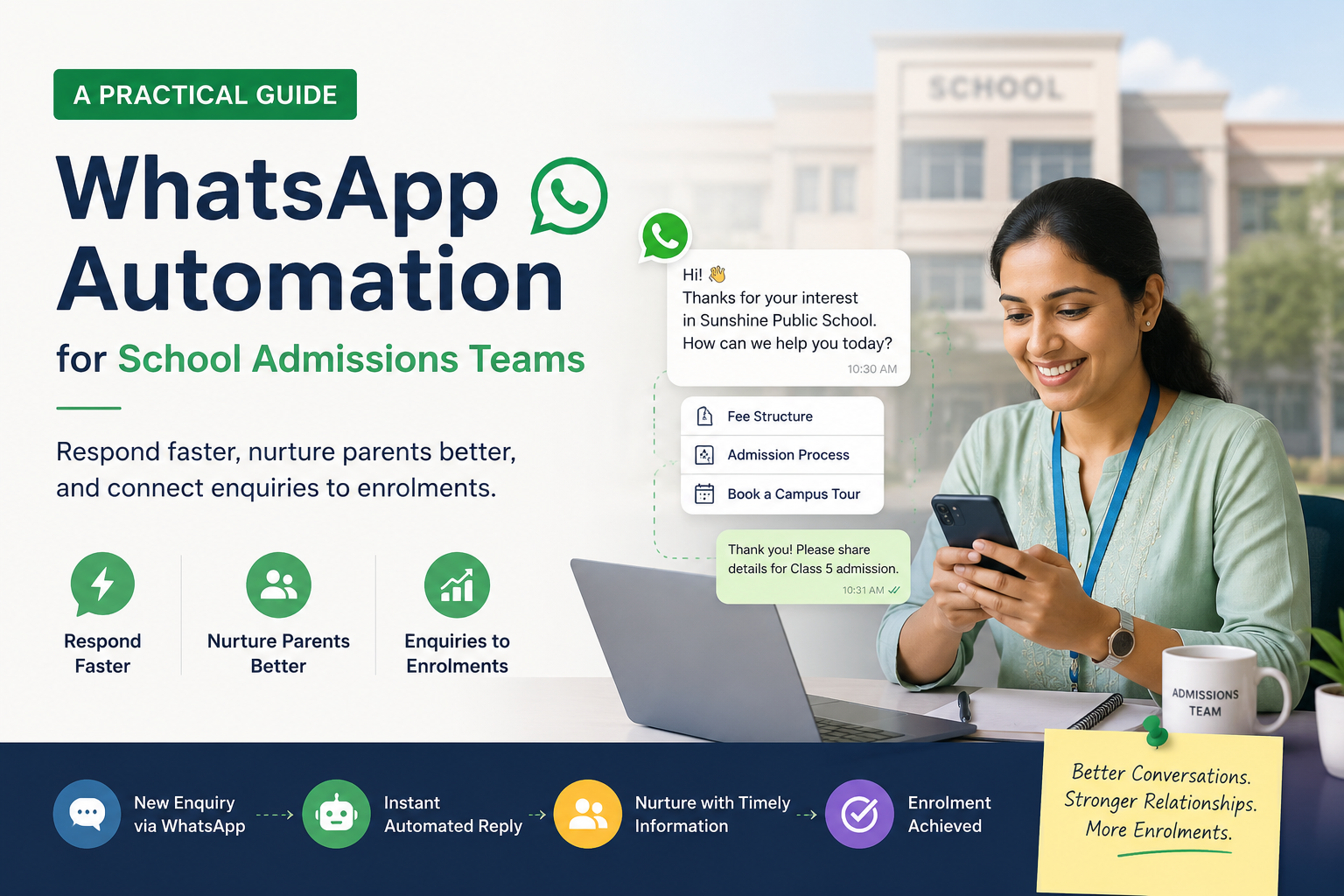
WhatsApp automation should support admissions conversations, not replace counsellor judgement. In India, WhatsApp is often where parents expect quick updates, reminders, directions, fee details, visit confirmations, and document checklists. But automation must be designed with consent, timing, and escalation rules.
Meta's WhatsApp Business Platform documentation explains that when a user messages a business, a 24-hour customer service window starts. Outside permitted windows, businesses typically need approved message templates for re-engagement. For schools, that means WhatsApp workflows should be planned before campaigns go live, especially for reminders, missed-call follow-ups, campus visit confirmations, and post-visit nurture.
A practical admissions WhatsApp setup includes:
- Clear opt-in: Parents should understand that the school may contact them about admissions on WhatsApp.
- Template governance: Approved templates should be factual, useful, and specific to admissions steps.
- Counsellor handoff: Automation should route serious parent replies to a person quickly.
- Stage-based messages: New enquiry, visit scheduled, visit reminder, application pending, document pending, and fee-stage follow-up should use different messages.
- Quiet hours and frequency rules: The CRM should prevent excessive messaging and protect the school's reputation.
- Complete history: WhatsApp replies should be visible inside the lead record, not locked inside individual phones.
Schools should avoid treating WhatsApp as a bulk broadcast channel. Parent trust is easy to lose when messages feel irrelevant or repetitive. The better approach is to use automation for timely, expected, service-like updates and leave persuasion, objections, and counselling to trained admissions staff.
For a detailed follow-up piece, add [INTERNAL-LINK: WhatsApp automation for school admissions - template and compliance guide].
How Meta Ads and CRM Should Work Together
Meta ads and CRM should work together as one loop: campaign, lead capture, qualification, follow-up, admission, and source-wise revenue review. If Meta leads are downloaded into spreadsheets and manually assigned later, the school loses speed and reporting quality.
Meta describes lead ads with instant forms as a way to generate and qualify leads by asking people to fill out a form. For schools, instant forms can work well when the form asks enough qualifying questions without adding unnecessary friction. Useful questions often include grade seeking admission, branch or location preference, curriculum interest, phone number, and preferred callback time.
The CRM should capture the lead instantly and apply rules such as:
- Assign nursery and primary enquiries to the right counsellor team.
- Route high-intent enquiries to a ringing queue or priority callback list.
- Tag campaign, ad set, creative, and form for later reporting.
- Trigger a WhatsApp acknowledgement when the parent has opted in.
- Create a first-call task with a strict service-level target.
- Send uncontacted leads to a follow-up queue before they become stale.
The important metric is not cost per lead alone. Schools should review cost per qualified lead, visit booking rate, visit completion rate, application start rate, enrolment rate, revenue per source, and lost reasons by campaign. A low-cost campaign that produces unqualified leads may waste counsellor time, while a higher-cost campaign may be profitable if it produces more enrolled students.
Swayam positions itself around this connected loop: Meta campaigns, UTM capture, WhatsApp nurture, pipeline stages, assignment history, win-loss reporting, and source ROI inside one CRM. That is the right category of problem for schools to evaluate: whether the system connects ad spend to admissions revenue, not whether it merely stores contacts.
Data Protection and Consent Considerations for Indian Schools
Schools should treat admissions data as sensitive operational data even when a formal legal review is handled separately. Admissions CRMs can include parent phone numbers, child names, grade interest, addresses, documents, notes, financial preferences, and communication history. That makes access control, consent records, retention policy, and audit trails important from day one.
India's Digital Personal Data Protection Act, 2023 includes specific provisions for children's personal data. Section 9 states that a data fiduciary must obtain verifiable consent from the parent or lawful guardian before processing personal data of a child, as prescribed, and must not undertake processing likely to cause detrimental effect on the well-being of a child. It also restricts tracking, behavioural monitoring, or targeted advertising directed at children, subject to prescribed exceptions.
For admissions operations, the practical implications are:
- Collect only what is needed: Do not ask for unnecessary child or family information at the first enquiry stage.
- Separate parent and child data: Ads and outreach should be directed at parents or guardians, not children.
- Maintain consent records: Store source, timestamp, form language, and communication opt-in where possible.
- Restrict access: Counsellors should see the leads they need, while exports and bulk actions should be controlled.
- Define retention: Decide how long lost enquiries, documents, and communication records are retained.
- Review vendor security: Ask where data is stored, who can access it, how roles work, and whether logs are available.
This is not legal advice, and schools should consult counsel for compliance decisions. Operationally, however, the CRM should make good data practice easier, not depend on manual discipline alone.
CRM Evaluation Checklist for Indian Schools
Schools should evaluate an education CRM through admissions outcomes, daily usability, and implementation support. A feature list is useful, but the real test is whether the team can run an admissions cycle without falling back to spreadsheets and personal WhatsApp accounts.
Core Questions to Ask Vendors
- Lead capture: Can the CRM capture Meta leads, website forms, calls, WhatsApp enquiries, imports, and walk-ins without manual copy-paste?
- Speed-to-lead: Can it assign leads immediately and alert counsellors?
- Pipeline fit: Can stages, fields, tags, and lost reasons match the school's admissions process?
- WhatsApp: Does it support approved templates, team inboxes, opt-in tracking, automation, and conversation history?
- Reporting: Can leadership see source-wise admissions, counsellor performance, follow-up aging, campaign ROI, and fee-stage movement?
- Multi-branch support: Can it route leads by location, grade, curriculum, and branch capacity?
- Data protection: Are roles, permissions, exports, audit logs, and data retention configurable?
- Implementation: Will the vendor help configure workflows, import existing data, train counsellors, and review adoption?
Red Flags
- The vendor shows dashboards but cannot explain the admissions workflow.
- WhatsApp is treated as a separate inbox instead of a pipeline-linked channel.
- Reporting stops at lead volume and does not connect to applications or enrolled students.
- Counsellors need too many clicks to update a lead after a call.
- There is no clear process for duplicate leads, reassignment, or stale follow-ups.
- Implementation is left entirely to the school team without admissions-specific setup support.
A good buying process includes a live demo using the school's own admissions stages. Ask the vendor to walk through one parent journey from Meta ad click to WhatsApp reply, counsellor call, campus visit, application, fee payment, and source-wise report.
A Practical Rollout Plan for Admissions Teams
The safest way to roll out an education CRM is to start with one admissions journey, prove adoption, and then expand. Trying to automate every scenario on day one often creates confusion.
- Map the current journey: List every lead source, handoff, stage, follow-up message, report, and spreadsheet currently used.
- Define the admission pipeline: Agree on stage names, entry criteria, exit criteria, and required fields.
- Clean existing data: Remove duplicates, standardise grade names, and decide which old leads should be imported.
- Connect priority sources: Start with Meta leads, website forms, phone enquiries, and WhatsApp because these usually drive the most leakage.
- Create follow-up rules: Define first-response targets, stale lead alerts, visit reminders, and post-visit tasks.
- Train counsellors on daily work: Focus on call logging, next follow-up dates, stage movement, notes, and lost reasons.
- Review weekly: Check uncontacted leads, overdue follow-ups, source quality, counsellor workload, and stage conversion.
- Optimise campaigns from CRM data: Shift budget based on qualified leads, visits, applications, and enrolled students.
The first month should be judged on adoption and data quality as much as admissions conversion. If counsellors do not update the CRM, leadership reports will not be trustworthy. If reports are not trustworthy, marketing and admissions will continue to debate lead quality without shared evidence.
Add [INTERNAL-LINK: CRM implementation plan for admissions teams - 30 day rollout checklist].
Metrics Every Admissions Head Should Monitor
Admissions heads should monitor metrics that connect marketing, counsellor activity, parent intent, and final enrolment. Lead volume is only the starting point.
- Lead volume by source: How many enquiries each channel produces.
- First response time: How quickly counsellors respond to new enquiries.
- Contact rate: The share of leads successfully reached.
- Qualified lead rate: The share of leads that match grade, location, curriculum, and timeline criteria.
- Visit booking rate: The share of qualified leads that book a campus visit or counselling session.
- Visit completion rate: The share of booked visits that actually happen.
- Application start rate: The share of visits or qualified leads that begin formal admission steps.
- Enrolment rate: The share of leads or applications that become confirmed admissions.
- Cost per enrolled student: Campaign spend divided by enrolled students from that campaign.
- Lost reasons: Fees, distance, curriculum mismatch, delayed response, no seat, competitor chosen, or no response.
These metrics should be reviewed by stage and by source. For example, a campaign may produce many leads but few visits, which suggests weak qualification. Another campaign may produce fewer leads but stronger application starts, which may justify a higher cost per lead. Without CRM data, this distinction is hard to prove.
Enquiry CRM vs school ERP module vs platform-backed admissions (India K-12)
When Indian schools compare enquiry tools, four stacks show up in almost every evaluation: spreadsheets plus personal WhatsApp, the enquiry module inside a school ERP, a dedicated admission CRM, and a platform-backed admissions revenue system that connects ads, counsellor queues, compliant WhatsApp, and fee-stage reporting. The right choice depends on whether you only need contact storage or a full revenue loop from Meta lead to enrolled student. Use the table below in vendor demos—ask each supplier to show live screens for every row, not slide claims.
| Capability | Spreadsheet / WhatsApp | School ERP enquiry module | Dedicated admission CRM | Platform-backed admissions revenue system |
|---|---|---|---|---|
| Follow-up automation | Manual reminders; no SLA alerts when a row ages | Basic task lists tied to ERP login; limited ad-source triggers | Stage-based tasks, stale-lead alerts, and template sequences on the enquiry record | Rules from lead source through visit and fee stages; automation hands off to counsellors with logged overrides |
| Counsellor queue | Hidden in personal phones; no branch-wide view | Shared inbox or module queue; often one campus at a time | Priority queue by grade, campus, and intent with reassignment history | Unified queue across branches with workload balancing and source-tagged routing |
| WhatsApp compliance | High ban risk; opt-in and templates not centralised | May bolt on WhatsApp; consent flags vary by ERP vendor | Template library, opt-in capture, and thread-on-lead for audits | Approved templates plus inbox on the same timeline as pipeline stages and consent logs |
| Fee / enrolment handoff | Fee status lives in finance spreadsheets; CRM context lost | Strong post-admission fees; weak link from ad click to enrolment ROI | Tracks fee-stage fields before ERP admission number exists | Connects campaign spend to enrolled students and fee milestones for principal reporting |
Next step for K-12 teams: If your evaluation is leaning toward platform-backed admissions—not another spreadsheet season—walk through the K-12 admissions revenue system on Swayam AI Labs with your real pipeline stages, WhatsApp templates, and Meta lead forms. Pair it with the Swayam platform overview when you need enquiry capture, counsellor tasks, and revenue ops on one stack.
Frequently Asked Questions
Is an education CRM necessary for a single school?
Yes, if the school receives leads from more than one source or has more than one person handling admissions. Even a single-campus school can lose enquiries when Meta leads, phone calls, WhatsApp messages, walk-ins, and spreadsheets are handled separately.
Can schools use WhatsApp without a CRM?
They can, but it is difficult to manage responsibly at scale. A CRM-linked WhatsApp setup gives the team conversation history, ownership, templates, opt-in context, and reporting. Personal WhatsApp use often creates visibility and continuity problems when counsellors change roles or leave.
What is the difference between an education CRM and a school ERP?
A school ERP usually manages internal administration after admission, such as fees, attendance, transport, exams, and parent communication. An education CRM manages the pre-admission journey: lead capture, counselling, follow-up, visits, applications, and enrolment conversion. Some schools need both.
How should schools measure CRM success?
Measure CRM success through response time, follow-up completion, qualified lead rate, visit completion, application starts, enrolments, source-wise ROI, and data quality. Adoption by counsellors is also a success metric because weak usage leads to weak reporting.
Should a school choose a generic CRM or an education-focused CRM?
A generic CRM may work if the school has strong internal operations and technical support. An education-focused CRM is usually better when the school wants admissions stages, counsellor workflows, WhatsApp nurture, campaign tracking, and education-specific reporting configured faster.
Conclusion
An education CRM for schools in India should be evaluated as an admissions operating system, not just a software purchase. The strongest systems connect lead sources, counsellor tasks, WhatsApp conversations, pipeline stages, and revenue reporting so teams can see what is working and fix what is leaking.
Start with the basics: capture every lead, respond fast, define pipeline ownership, record every follow-up, use WhatsApp responsibly, and report admissions by source. Once that foundation is stable, automation and campaign optimisation become much more useful.
For the next step, add [INTERNAL-LINK: school admissions CRM buyer guide - comparison checklist].
Sources Reviewed
- UDISE+ official portal: https://udiseplus.gov.in/
- Ministry of Education UDISE+ 2025-26 release via Press Information Bureau: https://www.pib.gov.in/PressReleasePage.aspx?PRID=2282141&lang=2®=48
- IBEF summary of IAMAI-Kantar Internet in India 2024 report: https://www.ibef.org/news/india-s-internet-users-to-exceed-900-million-in-2025-driven-by-indic-languages
- TRAI telecom subscription reports page: https://www.trai.gov.in/release-publication/reports/telecom-subscriptions-reports
- Meta WhatsApp Business Platform documentation: https://developers.facebook.com/documentation/business-messaging/whatsapp/messages/send-messages
- India Code, Digital Personal Data Protection Act, 2023: https://www.indiacode.nic.in/handle/123456789/22037
- Swayam product website: https://swayamapp.com/