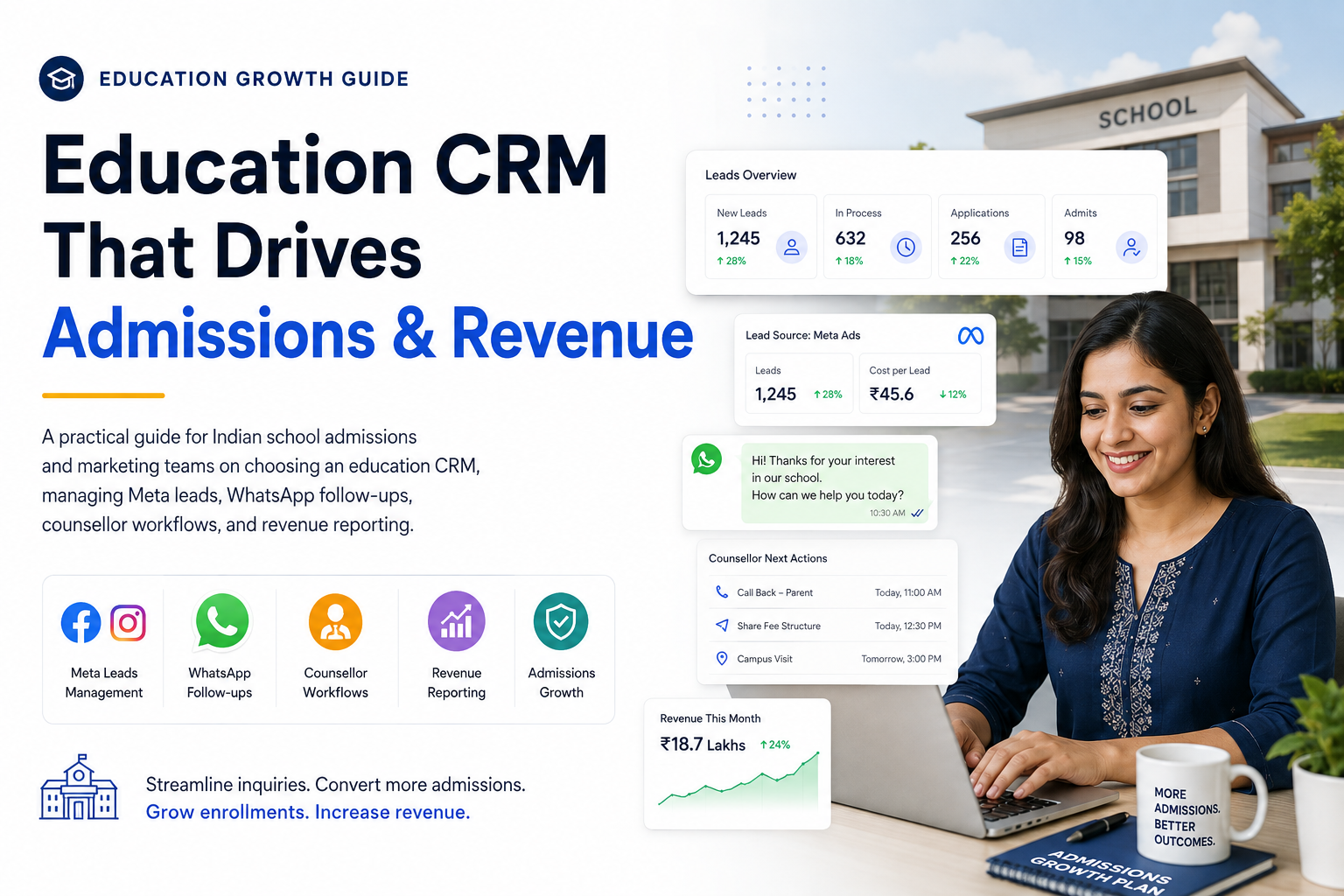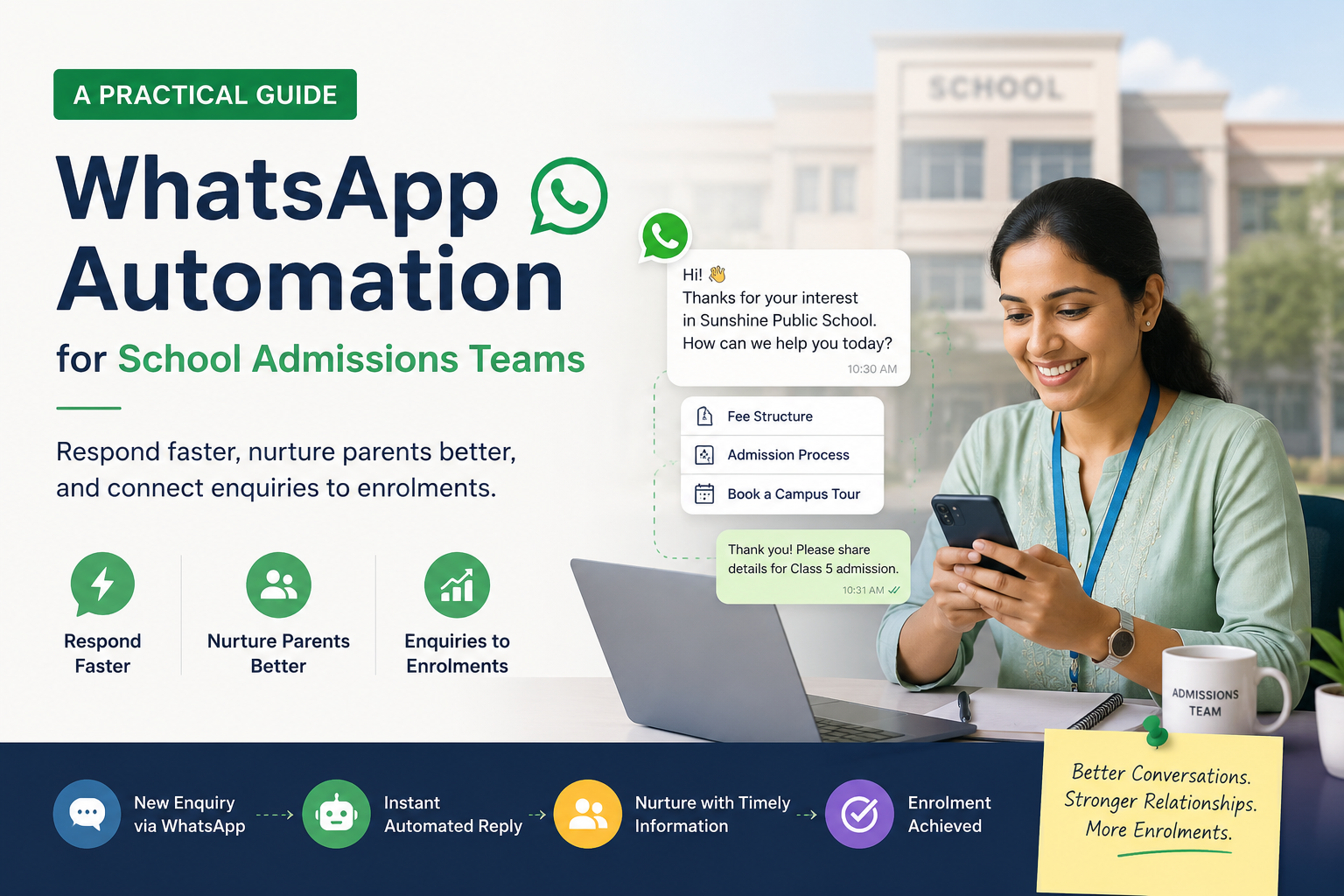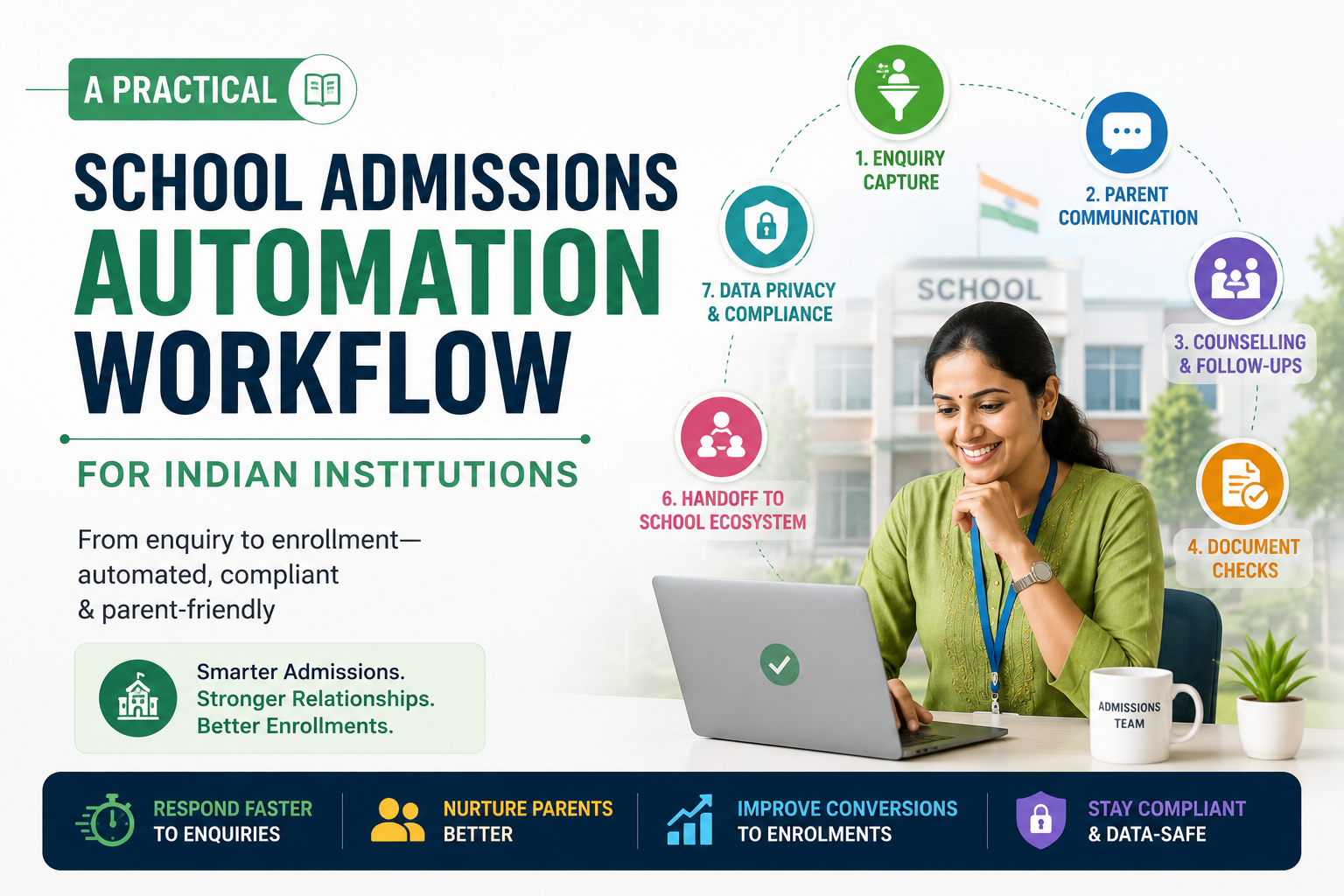
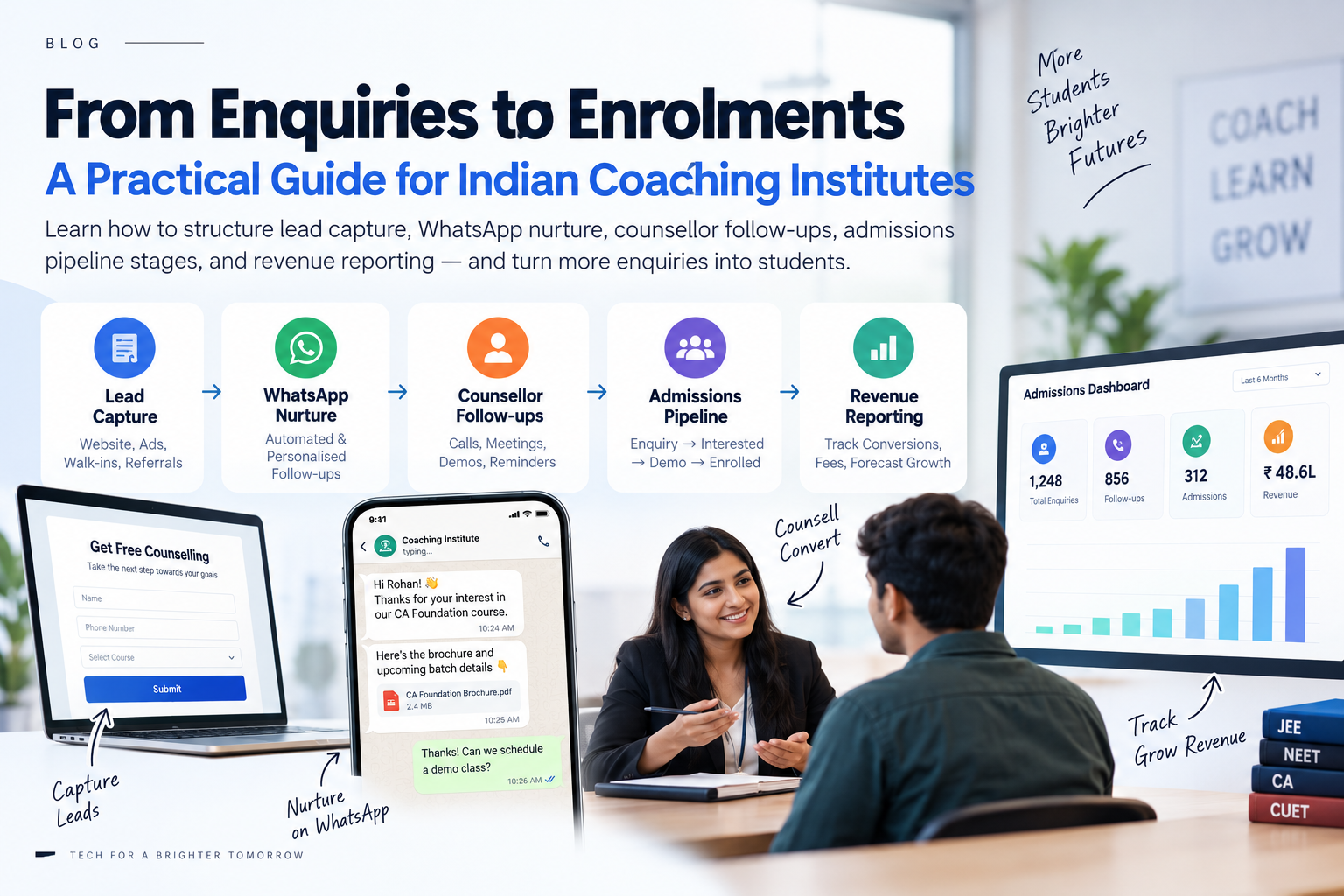
Lead management for coaching institutes is the operating system that turns enquiries from Meta ads, referrals, websites, walk-ins, and WhatsApp into tracked admissions conversations. Without it, teams often celebrate lead volume while counsellors struggle with duplicate enquiries, delayed follow-ups, unclear ownership, and weak visibility into which campaigns actually produce enrolled students.
For Indian admissions teams, the problem is not only marketing. Demand is active, parents and students expect fast mobile communication, and counsellors need a practical pipeline that helps them prioritise the next best action. ASER 2024 reported that school enrollment for ages 6 to 14 remained very high at 98.1 percent in 2024, while CEDA Ashoka's 2025 analysis of private tuition and coaching showed how deeply supplementary learning has entered household education decisions. The opportunity is real, but it is won through disciplined follow-up, not lead collection alone.
Lead management for coaching institutes (India)
Lead management for coaching institutes in India is the practice of capturing every admission enquiry—from Meta lead ads, website forms, referrals, walk-ins, and WhatsApp—into one shared pipeline with a named counsellor owner, timed follow-ups, and stage history until the student enrolls, nurtures, or closes with a documented reason. JEE, NEET, boards, and foundation centres cannot rely on personal phones and duplicate spreadsheets when parents expect fast mobile replies and managers need source-to-enrolment truth. Counsellor ownership means one accountable owner per lead at a time, with clear handoffs when volume spikes or staff are on leave. Stages should mirror real decisions: new enquiry, contact made, counselling or demo booked, attended, trial or application, fee discussion, enrolled, nurture, or lost. Platform-backed teams compare an admissions revenue system for coaching institutes, the Swayam AI Labs platform, and counsellor capacity for Meta lead volume before scaling spend.
| Enquiry source | First response SLA | Pipeline stage |
|---|---|---|
| Meta lead ad or landing-page form | Under 10 minutes in peak hours; same-day callback if after hours | New enquiry → contact made → demo or counselling scheduled |
| Referral or walk-in at front desk | Immediate acknowledgement; counsellor assigned before the parent leaves | Qualified → visit logged → trial or application |
| WhatsApp message on institute number | Template ack within minutes; human reply inside business SLA | Active conversation → fee discussion → enrolled or nurture |
| Website chat or missed inbound call | Callback within 2 hours; WhatsApp follow-up if no answer | Not reachable → recovery task → lost with reason or re-open |
Key Takeaways
- A coaching institute should manage leads through clear stages: new enquiry, qualified, counselling scheduled, attended, application or trial, fee discussion, enrolled, lost, and nurture.
- Speed matters. Harvard Business Review's lead response research shows many companies respond too slowly to online enquiries, making response SLAs a practical admissions priority.
- WhatsApp should not be treated as a broadcast-only channel. Meta-commissioned Kantar research across 22 markets found that 73.3 percent of consumers prefer messaging when communicating with a business.
- Campaign reporting should connect ad source, counsellor activity, stage movement, fee status, and final admission outcome.
- Swayam fits this workflow as an agentic CRM for Meta ads, WhatsApp nurture, and pipeline operations, but institutes should still define their own process, SLAs, and admission metrics.
What Lead Management Means for a Coaching Institute
Lead management is the process of capturing every enquiry, assigning it to the right counsellor, qualifying student intent, moving the lead through admission stages, and measuring the final revenue outcome. In a coaching institute, this usually involves students and parents, multiple courses, batches, locations, fee plans, entrance exams, and repeated follow-ups.
A practical system must answer five questions every day. Which leads came in? Who owns each lead? What is the current stage? What is the next action? Which campaigns and counsellors are producing enrolled students? If the team cannot answer these quickly, the CRM is only a contact database.
For a deeper topic cluster, place an internal link here: [INTERNAL-LINK: coaching institute automation to target page on admissions operations].
Why Coaching Institutes Lose Leads After Paying for Them
Most lead leakage happens after the enquiry is generated. Meta ads, landing pages, referral campaigns, and events can create demand, but admissions revenue depends on how fast and consistently the team handles the next conversation.
- Delayed first response: A student may enquire at night, during class hours, or while comparing several institutes. If nobody responds quickly, the lead cools down.
- No single owner: When a lead sits in a shared spreadsheet or WhatsApp group, multiple counsellors may call the same parent or nobody may call at all.
- Weak qualification: Teams often record only name and phone number. They also need course interest, exam target, class, city, budget sensitivity, timeline, and parent involvement.
- Follow-up without context: A counsellor should know whether the student downloaded a brochure, clicked a WhatsApp message, attended a webinar, visited a branch, or discussed fees.
- Campaign reporting stops at lead count: If marketing cannot see admissions and revenue by campaign, budget decisions become guesswork.
Harvard Business Review's article The Short Life of Online Sales Leads, based on research by James Oldroyd and colleagues, highlighted that companies often respond far too slowly to online enquiries. The exact conversion effect will vary by institute, course, city, and season, but the operational lesson is durable: speed-to-lead should be measured and managed.
The Practical Pipeline Stages to Use
A coaching institute pipeline should be simple enough for counsellors to update during a busy admission season and detailed enough for leadership to spot bottlenecks. Start with these stages and adjust them to your admission model.
- New enquiry: The lead has entered from Meta ads, website, referral, walk-in, inbound call, webinar, or WhatsApp.
- Contacted: A counsellor has attempted or completed the first call or WhatsApp conversation.
- Qualified: The team has confirmed course interest, exam or class, location, admission timeline, and decision-maker.
- Counselling scheduled: A demo, counselling call, branch visit, webinar, or assessment has been booked.
- Counselling attended: The student or parent attended the scheduled interaction.
- Application or trial: The student has taken a trial class, assessment, application step, or batch selection action.
- Fee discussion: The conversation has moved to pricing, scholarship, instalment, discount, or payment deadline.
- Enrolled: Payment, documentation, or confirmed admission is complete according to your institute's policy.
- Lost: The lead is closed with a reason such as wrong course, low intent, competitor selected, budget issue, no response, or location mismatch.
- Nurture: The lead is not ready now but may convert for a later batch, exam cycle, or sibling course.
This structure keeps the pipeline close to real admissions work. It also makes stage conversion visible: new to contacted, contacted to qualified, qualified to counselling attended, attended to fee discussion, and fee discussion to enrolled.
Step 1: Capture Every Lead with Source and Context
By the end of this step, every enquiry should enter one system with source, campaign, course interest, and contact details intact. Lead capture should not depend on manual copy-paste from ads, forms, spreadsheets, and WhatsApp chats.
For Meta campaigns, capture campaign name, ad set, creative, form, landing page, and timestamp wherever possible. For website and offline enquiries, use standard fields so the team can compare performance across channels. For WhatsApp enquiries, save the conversation source and first message context.
The minimum fields are:
- Student name and parent name when available
- Mobile number and WhatsApp opt-in status
- Course, exam, class, or batch interest
- City, branch, or online preference
- Lead source, campaign, and creative
- Admission timeline and urgency
- Current stage and counsellor owner
Meta's Q1 2025 earnings transcript stated that WhatsApp had more than 3 billion monthly active users and described business messaging as a major opportunity. For Indian education marketers, this supports a practical point: messaging is not a side channel. It should be connected to lead capture and pipeline tracking.
Step 2: Assign Leads by Rules, Not by Memory
By the end of this step, every lead should have a clear owner and a first-response deadline. Assignment rules reduce confusion during high-volume periods such as board results, entrance exam announcements, scholarship tests, and batch launches.
Useful routing rules include course, branch, city, language, lead source, seniority, and counsellor workload. For example, IIT-JEE enquiries from Kota may go to one team, NEET repeaters to another, and online foundation course leads to a central team. High-intent leads such as fee-page visitors or missed inbound calls may deserve priority routing.
Set service levels for follow-up:
- Hot inbound calls and WhatsApp replies: immediate queue
- Fresh paid leads during working hours: first attempt within minutes
- After-hours leads: automated acknowledgement plus next working-hour task
- Unreachable leads: structured retry pattern across call and WhatsApp
- Old nurture leads: campaign-based reactivation instead of daily manual calling
For a deeper operational guide, place an internal link here: [INTERNAL-LINK: speed to lead for admissions teams to target page on response SLAs].
Step 3: Qualify Student Intent Before Heavy Selling
Qualification helps counsellors spend the most time on leads that can realistically convert while keeping lower-intent leads in nurture. It should feel like useful counselling, not interrogation.
A practical qualification framework for coaching institutes includes need, fit, urgency, authority, and affordability. Need means the student is preparing for a relevant exam, class, or skill outcome. Fit means the batch, format, city, and academic level match. Urgency means the student has a real admission timeline. Authority means the decision-maker is involved. Affordability means the fee plan is not completely misaligned.
Questions Counsellors Can Use
- Which exam, class, or outcome are you preparing for?
- Are you looking for classroom coaching, online classes, hybrid support, or test series?
- When do you want to join a batch?
- Have you attended any demo class or counselling session elsewhere?
- Who will be involved in the final fee decision?
- What is the main concern: results, faculty, distance, schedule, fees, or doubt support?
The goal is not to reject leads too early. The goal is to match the right next step: counselling call, demo class, scholarship test, branch visit, fee plan discussion, or nurture sequence.
Step 4: Use WhatsApp Automation for Helpful Nurture
WhatsApp automation should help students and parents get timely information without forcing counsellors to type the same messages all day. It works best when it is consent-based, contextual, and connected to pipeline stages.
Meta's State of Business Messaging report, based on Kantar research conducted from April to September 2025 across 11,056 adults in 22 markets including India, found that 73.3 percent of consumers prefer messaging when communicating with a business. The same report states that 72.4 percent are more likely to purchase from a brand that offers messaging and 66.8 percent feel frustrated when messaging is not offered as a contact option.
For coaching institutes, the lesson is practical: WhatsApp should support the admission journey with relevant next steps. Avoid generic blasts that ignore course, exam, batch, and stage.
Useful WhatsApp Sequences
- New lead acknowledgement: Confirm the enquiry and ask one qualifying question.
- Brochure and course fit: Send course details based on selected programme, not the full catalogue.
- Counselling reminder: Remind the student or parent before a booked call, demo, webinar, or branch visit.
- Missed counselling follow-up: Offer a reschedule link and ask for preferred timing.
- Fee deadline reminder: Share payment steps, scholarship validity, and contact details for questions.
- Long-term nurture: Send exam tips, batch openings, result updates, and parent-focused guidance for colder leads.
Swayam can support this kind of workflow by connecting Meta ads, WhatsApp nurture, and CRM pipeline operations. The important design choice is to trigger messages from stage and intent, not from a one-size-fits-all calendar.
Step 5: Build Counsellor Workflows Around Next Actions
A lead management system should make the next action obvious. Counsellors should not begin each day by scrolling through spreadsheets, call logs, and WhatsApp chats to decide who needs attention.
Use task queues by priority: new hot leads, scheduled counselling today, missed calls, payment follow-ups, no-response retries, and nurture callbacks. Each lead record should show conversation history, stage, last activity, next task, and reason for delay. Managers should be able to see stuck leads without asking every counsellor for manual updates.
Daily counsellor dashboard fields should include:
- New assigned leads
- Overdue first responses
- Today's counselling sessions
- Missed or rescheduled sessions
- Fee discussion follow-ups
- Payment pending leads
- Lost leads requiring reason codes
For a related operations article, place an internal link here: [INTERNAL-LINK: admissions counsellor productivity to target page on team workflows].
Step 6: Measure Revenue, Not Only Leads
The most useful dashboard connects marketing spend to admissions outcome. Lead count is necessary, but it is not enough. Admissions heads need to know cost per qualified lead, counselling attendance rate, fee discussion rate, enrollment rate, revenue by campaign, and counsellor conversion by stage.
Meta's Q1 2025 results stated that Family of Apps ad revenue grew 16 percent year over year in Q1, with ad impressions up 5 percent and average price per ad up 10 percent. For institute marketers, this is a reminder that paid acquisition costs can move. If reporting stops at form submissions, budget can shift toward campaigns that generate cheap but low-intent leads.
Track these core metrics:
- Lead volume by channel, campaign, course, and city
- First response time by source and counsellor
- Contact rate and qualification rate
- Counselling scheduled and attended rate
- Fee discussion and payment completion rate
- Revenue, not just enrollments, by campaign
- Lost reasons by source and stage
- Reactivation conversions from old leads
This is where coaching institute automation becomes commercially useful. The system should help leaders stop asking, Which campaign generated leads? and start asking, Which campaign generated admissions at an acceptable cost?
Common Mistakes to Avoid
Counting Duplicate Leads as Demand
Duplicate enquiries from the same student or parent can inflate campaign performance. Use phone-number matching and source history so repeat enquiries enrich the record instead of creating confusion.
Sending Every Lead the Same WhatsApp Message
A class 9 foundation lead, a NEET dropper, and a parent asking about fees need different information. Segment messages by course, stage, and intent.
Letting Counsellors Own Data Differently
If one counsellor uses notes, another uses WhatsApp labels, and another uses a spreadsheet, management loses visibility. Define mandatory fields and make updates easy.
Optimising Meta Ads Without Admission Feedback
Campaign decisions should include qualified leads, counselling attendance, fee discussions, and enrollments. Cheap leads are not always profitable leads.
Closing Lost Leads Without Reasons
Lost reasons reveal pricing issues, wrong targeting, branch mismatch, poor timing, weak course fit, and competitor pressure. Without reason codes, the team loses learning.
How Swayam Fits This Pipeline
Swayam is positioned as an agentic CRM for institutes that want Meta ads, WhatsApp nurture, and pipeline operations connected in one growth system. In practical terms, that means the CRM should not sit after marketing. It should help run the loop from ad click to WhatsApp conversation to counsellor action to admission outcome.
For an admissions head, the evaluation question is straightforward: can the system show where money is being spent, where leads are getting stuck, and which actions move students closer to enrollment? For a sales leader, the question is whether counsellors get cleaner queues and fewer manual updates. For a marketing team, the question is whether campaign data improves based on admission quality, not just lead volume.
A sensible rollout starts with one course or branch, a defined pipeline, agreed SLAs, WhatsApp templates, counsellor dashboards, and weekly reporting. Once the process works, expand to more courses, cities, and campaign types.
Frequently Asked Questions
What is the best CRM setup for a coaching institute?
The best setup is one that captures all sources, assigns every lead, supports WhatsApp follow-up, tracks admission stages, and reports revenue by campaign. Avoid systems that only store contacts without pipeline movement.
Should coaching institutes use WhatsApp automation?
Yes, when it is used for timely, relevant, consent-based communication. Automation is useful for acknowledgement, reminders, brochure sharing, missed-session recovery, payment nudges, and long-term nurture. It should not replace counsellor judgement for high-intent conversations.
How many pipeline stages should an institute use?
Most institutes need 8 to 10 stages. Too few stages hide bottlenecks, while too many stages slow counsellors down. Start with new enquiry, contacted, qualified, counselling scheduled, attended, application or trial, fee discussion, enrolled, lost, and nurture.
How should Meta ad performance be judged?
Judge Meta ads by qualified leads, counselling attendance, fee-stage movement, enrollment, and revenue. Lead volume and cost per lead are useful early indicators, but they should not be the final measure.
Sources Used
- ASER Centre, ASER 2024 National Findings: https://asercentre.org/wp-content/uploads/2022/12/ASER-2024-National-findings.pdf
- Press Information Bureau, Annual Status of Education Report 2024 summary, published February 4, 2025: https://www.pib.gov.in/PressReleseDetailm.aspx?PRID=2099725
- WhatsApp Business, The State of Business Messaging, Kantar research commissioned by Meta, conducted April to September 2025: https://whatsappbusiness.com/resources/resource-library/state-of-business-messaging/
- Meta Platforms, Q1 2025 Earnings Call Transcript, April 30, 2025: https://s21.q4cdn.com/399680738/files/doc_financials/2025/q1/Transcripts/META-Q1-2025-Earnings-Call-Transcript-1.pdf
- Harvard Business Review, The Short Life of Online Sales Leads, March 2011: https://hbr.org/2011/03/the-short-life-of-online-sales-leads
- Centre for Economic Data and Analysis, Ashoka University, Shadow Classrooms: Grip of Private Tuitions on Indian Education, October 14, 2025: https://ceda.ashoka.edu.in/shadow-classrooms-grip-of-private-tuitions-on-indian-education/
Conclusion
Lead management for coaching institutes works when it is treated as a revenue process, not an admin task. Capture every enquiry with source context, assign it quickly, qualify intent, use WhatsApp automation carefully, guide counsellors with next actions, and measure enrollment outcomes by campaign.
Swayam can support this pipeline for institutes that want Meta ads, WhatsApp nurture, and admissions operations working together. The right starting point is a clear process: define stages, response SLAs, ownership rules, message flows, and revenue dashboards before scaling spend.